Author Archives: inikyoto

On the performance of Sagi at the Seiran Noh 2016

We publish here some thoughts on Udaka Michishige’s performance of Sagi (The Heron), by Rebecca Teele Ogamo.

The Seiran Noh performance of Sagi on September 11th, 2016 celebrating Udaka Michishige’s 70th birthday was one of the plays featured in the Kansai area Noh reviews in the Nohgaku Times. As the critic points out, the story is a demonstration of how a bird, without spirit or mind, shows its gratitude towards the emperor and has no real emotional expression. This being the case, the success or failure of a performance rests on the actor’s skills, refined over time, to portray the sense of purity and innocence of the heron through making the face a vehicle of abstract expression, as a mask is not used, but is performed hitamen, or with the face as a mask, or instead of a mask. The critic was especially impressed by the way that Michishige was able to do this, keeping his face completely devoid of expression. His portrayal of the utter stillness of the bird when it stopped, as though perching without moving had a majestic grace, and the seemingly effortless performance of the unique and extremely difficult dance of the heron, meticulously and without any wasted movement, seemed to reveal to the audience the actual heron on the shore of the pond.


michsihige-sagi

Udaka Michishige as ‘the heron’ in Sagi. Udaka Seiran Noh. Kongō Nōgakudō, 11 September 2016. (Photo: Oka Tetsuya)


I have seen Udaka-sensei in other hitamen roles, but always as in the role of a living person, as in Hachinoki or Mochizuki, or of a ghost manifesting as a living person as in the first half of Atsumori. This was the first time to see him in the role of a non-human creature, relying on completely on focused movement, rather than a mask, to portray the essence of the heron. I was startled when I realized that I was no longer aware of an actor or his face, but felt I was watching a heron as it danced. The critic seemed to confirm this experience. “I wonder what kind of Sagi I will be?” Michishige mused one day after a mask carving class. I think it was the natural result of years of dedicated uncompromising practice.

Whatever our path, challenges are limitless, and the base and foundation on which we pursue them must always be a constant refining of basic skills.

For INI, too, this means a continuing renewal of our commitment to sharing and exploring the traditions of Noh. We grow and gain energy through shared experiences of how we test our limits. Please let us know about your path and progress, and know we support you in your challenges.”

Rebecca Teele Ogamo

michishige-sagi-nogaku-times

Shinonome Noh 2016: Tamura

INI founder Udaka Michishige is a descendant of the Udaka Clan, serving the Matusdaira feudal lords in Matsuyama, Shikoku as Noh actors from 1712 until the beginning of the Meiji period.

In Matsuyama, Michishige has an okeikoba training space, where INI members also train intensively. Regular performance events in Matsuyama include Shinonome Noh and the Matsuyama Shimin Noh. The Shinonome Noh is an annual Noh and Kyogen event taking place at Shinonome Jinja, a shinto shrine located on the hill dominated by Matsuyama Castle. Michishige has collaborated with Shinonome shrine cataloguing and restoring the vast Noh masks and costumes collection.

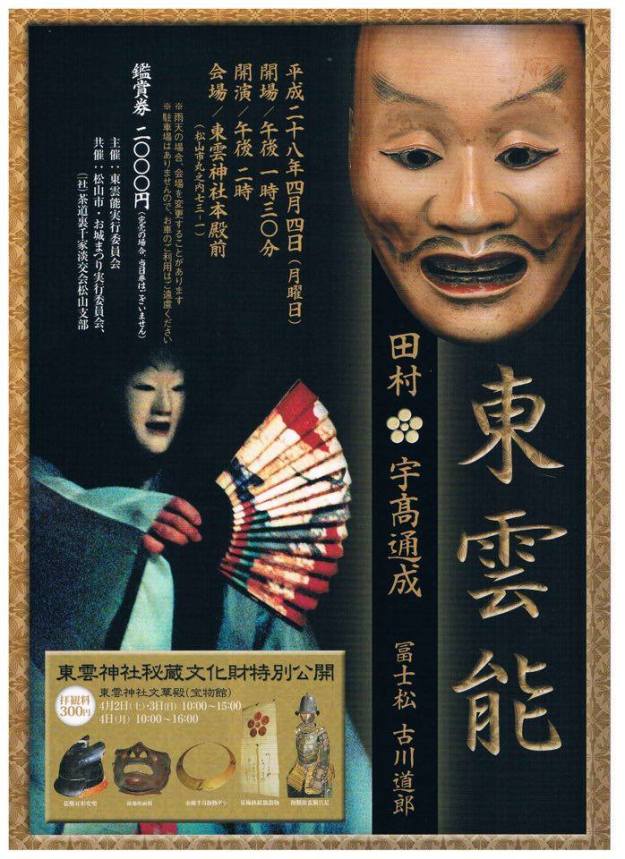
This year’s Shinonome Noh performance will take place on April 4th (Monday) from 14:00 (gates open at 13:30), and will feature the Kyogen Fujimatsu and the Noh Tamura. INI member Diego Pellecchia will sing in the chorus (in the program he is listed under his Japanese name, 高谷大悟 Takaya Daigo). Tickets: 2000yen.

12895357_578673225643811_295263240_n

Tamura tells the founding myth of Kiyomizu Temple in Kyoto in the early 9th century. Having defeated a rebellion in the East lands thanks to the divine intervention of the Bodhisattva Kannon, General Sakanoue Tamuramaro became a benefactor of the temple. The first half of the play, set at Kiyomizu temple in spring, is characterised by the images of cherry flowers in full bloom. By contrast, the second half describes the battle between Tamura’s army and the rebels, ending with words of praise for Kannon.

12900110_578673245643809_32590024_n

Noh changes with imagination | Tatsushige Udaka | TEDxKyotoUniversity TEDx Talks

Udaka Tatsushige’s TEDxKyotoUniversity talk on Noh is finally available with English subtitles! Enjoy and let us know what you think!

Noh, a classical Japanese musical drama, is not just what you see with your eyes, but what see with your mind too! This talk/performance will show you that in interpreting Noh, imagination is your limit!

Tatsushige Udaka was born in Kyoto, and started his career in Kokata acting from the young age of three years old. He was trained by the 26th head of the Kongo School, Hinasori KONGO, as well as by his father, Michishige UDAKA. Performing since he was young, he has had extensive stage and teaching experience in Noh Threatre. He has travelled, performed, taught, and demonstrated Noh in Japan, South Korea, France, and the United States throughout the last decade. Currently, he is based in Kyoto.

Udaka 2015 Independence Day, and INI Gala Recital 2016

In the early hours of September 13th 2015 Udaka Michishige continued with putting the finishing touches on the Deigan mask he would use later that day in his performance of Teika, the center piece of the 16th Seirannoh-no-kai at the Kongo Noh Theatre: adding more color, polishing, pausing to check the effect once again. This was the latest effort in the search for the essence of the expression of the Deigan mask, in this case for the essence that would most effectively portrayal his interpretation of the spirit of Princess Shokushi Naishinno. As always the process was continuing until the last possible moment.

His thoughts at this time as he kept on with this search included welcoming the 45th observance of his independence as a Noh actor and also his wishes for INI members. “Independence” can mean embarking on a lonely road and uncompromising battle of seeking the essence of your art. Michishige continues to be his own harshest critic and taskmaster, but he also treasures and finds strength in fellow travellers on the path. He hopes that you, too, as his fellow travellers are keeping to your path of seeking the highest essence in your endeavours.

Michishige also looks forward to sharing in training and performing Noh with as many of you as possible in the Gala Noh Recital at the Kongo Noh Theatre on August 21, 2016. More details will be coming soon, but please put the date down on your calendar and get in touch with us with any questions. As always at INI will do what we can to facilitate your participation.

In closing, the performance of Teika was very well received. Here are a few photos from the performance though they are hardly a substitute for the experience of the performance itself.

Rebecca Teele Ogamo

31st Matsuyama Shimin Noh 2015 – Fujito

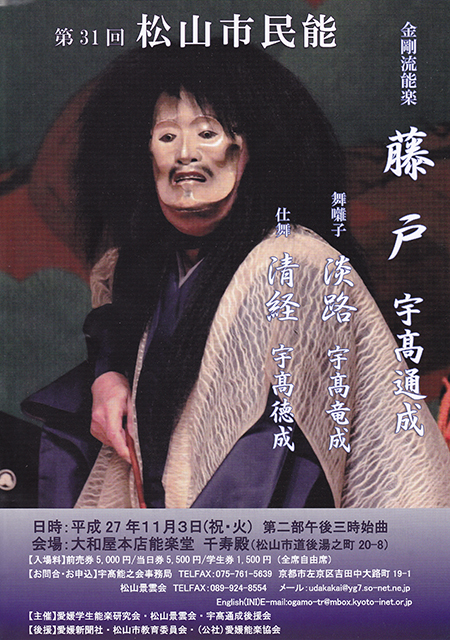
On November 3rd 2015 Udaka Michishige will perform the Noh FujitoUdaka Tatsushige, his elder son, will perform the maibayashi (chant and dance excerpt with instrumental dance) from the Noh Awajiwhile his younger brother Norishige will perform the shimai Kiyotsune.

In Fujito the spirit of the young fisherman who revealed to Sasaki no Moritsuna the shallows at the straits of Fujito so that he is able to take the enemy by surprise, appears and acts out how he was killed by Moritsuna, his body left to sink at the straits to ensure that the secret would not be revealed to anyone else. The Buddhist service Moritsuna offers on his behalf enables the spirit to gain enlightenment.

From 10:00 to 14:30 students of Udaka Michishige will perform dance and chant excerpts. INI members will also participate with the following shimai: Diego Pellecchia (高谷大悟): Kamo, Elaine Czech: MiwaThe performance of KIyotsuneAwaji, and Fujito will begin at 15:00.

FUJITO_chirashi-b_15

31st Matsuyama Shimin-Noh performance

3 November 2015 Matsuyama (Ehime prefecture) Dogo Yamatoya Nohgakudo 10:00 – 17:00

Part I (10:00 – 14:30)
Student recital of chant and dance – free of charge

Part II (15:00 – 17:00)

Shimai: Kiyotsune (kuse). Shite: Udaka Norishige

Maibayashi: Awaji. Shite: Udaka Tatsushige
Noh: Fujito. Shite: Udaka Michishige

Tickets: General Admission ¥5,500   Advance Sale: ¥5,000
Student Admission ¥1,500

For questions and reservations contact us.

KYOTO INI Main Offices, Training Center 111 Satta-cho, Kami-takano, Sakyo-ku, Kyoto 606-0047 Fax: +81 (075) 701-1058 Email: ini.kyoto (at) gmail.com


FUJITO_chirashi-a_15_0001

Lecture/demonstration + photo exhibition in Milan October 14 ~ 17

CRT Milan, AsiaTeatro and the International Noh Institute have organised a four-day event series in Milan, Italy from October 14th to October 17. The events include lectures on the origins, history and aesthetics of Noh, a photography exhibition Fabio Massimo Fioravanti‘s (running until November 1st), and afternoon demonstrations (15-16-17) by INI member and Kongo school certified instructor Monique Arnaud.

Detailed info on the program, times and prices here (in Italian).

Kongo-school certified instructor Monique Arnaud (Photo: Fabio Massimo Fioravanti)

Kongo-school certified instructor Monique Arnaud (Photo: Fabio Massimo Fioravanti)

INI intensive workshop with Theatre MITU

Last days of summer in Kyoto! Time to look back at what we have done during the summer. One of the highlights has been an intensive 2-day workshop with New York-based collective Theatre Mitu. The workshop took place in June 2015, at Iori Machiya, in Kyoto. Theatre Mitu periodically organises intensive ‘summer camps’ aimed at exploring non-Western traditions. Participants are both Mitu’s resident artists and also university students – I found this a particularly interesting formula, in which old-timers and perspective professionals can learn from each other.

Michael Littig, one of Theater Mitu’s Japan Artist Intensive programme members, sent us a kind message: “I thought Tatsushige-san was a very direct, clear, and well informed teacher.  I found his enthusiasm to be contagious, and I would highly recommend him to any artist who is interested in exploring Japanese Noh.”

We look forward to meeting Theatre Mitu’s again soon!

DSCF1775 DSCF1781

INI trip to the Kyoto National Museum

Screen Shot 2015-07-19 at 16.08.07Today a bunch of us visited the Feature Exhibition: Japanese Masks – from religious procession to Noh performance at the Kyoto National Museum. The exhibition featured gyodo processional masks representing bodhisattvas, as well as some Muromachi period Noh masks. It was a great opportunity to admire ancient artworks and to compare different styles. We had a great time!
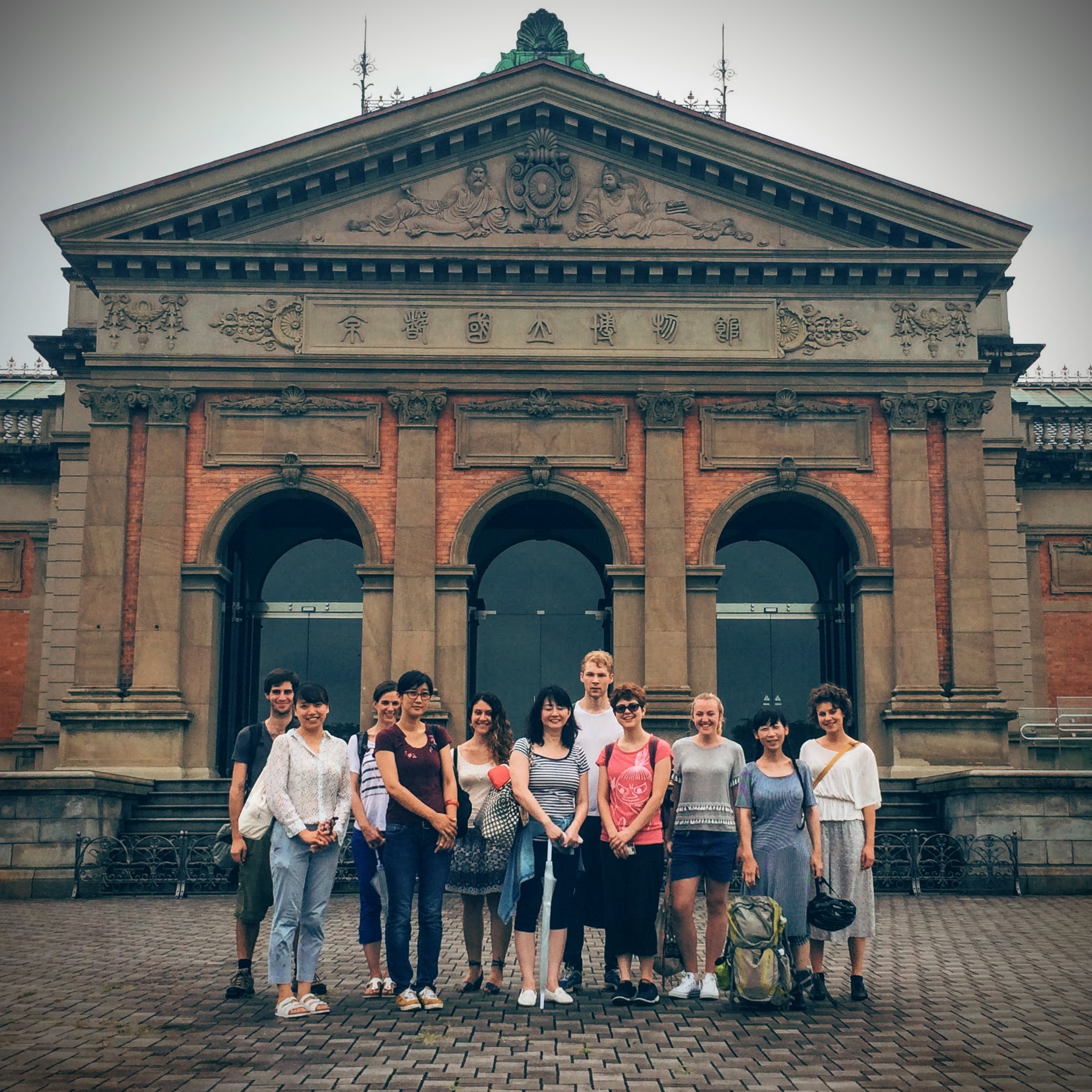
INI participants – Summer 2015

Kongo Monthly Noh 26 April 2015 – ‘Oshio’

On Sunday 26 April 2015 Udaka Michishige will perform the Noh Oshio, a piece not frequently put on stage by the Kongo School. The play is attributed to Konparu Zenchiku, and draws from the Tales of Ise and from the poetry collection Kokinshu. The main character is in fact the celebrated Heian period poet Ariwara no Narihira (825-880), a central character in other Noh plays, such as the third category (women Noh) plays Kakitsubata and Izutsu. However in Oshio Narihira appears as himself – first as an old man, and later in his original garb, as a Heian period courtier.

26 April 2015 (Sun) from 13:30. Noh: Oshio – Udaka Michishige. Kongo Noh Theatre. Kyoto.

Ariwara no Narihira in a painting by Kano Tanyu

Oshio synopsis by Rebecca Teele

A Man goes with his Companions to Mt. Oshio having heard that the cherry blossoms are in full bloom there. Among the many flower viewers is an Old Man carrying a branch of blossoms. The Men speak with him and are impressed by his elegant expression of appreciation for the blossoms. He quotes poems by Ariwara no Narihira (825-880) nobleman and courtier, in particular one relating to the visit to the area by the Empress of the Second Ward, Fujiwara no Koshi, who was secretly his lover for a time. The poem reads: Ohara ya, Oshio no yama mo, kyo koso wa, kamiyo no koto mo, Omoiizurame and is translated by Helen McCullough in Tales of Ise as: “On this auspicious day, the divinity of Mt. Oshio at Ohara, will surely remember, what happened long ago, in the Age of the Gods.” The Old Man is, in fact, the spirit of the ‘Man of Old’, the poet Ariwara no Narihira in a transformed state. Later he appears in his true form in a blossom decorated ox cart and dances, remembering incidents of the past and praising the beauty of the cherry blossoms.

For more information on the performance, or to reserve a ticket contact the INI.