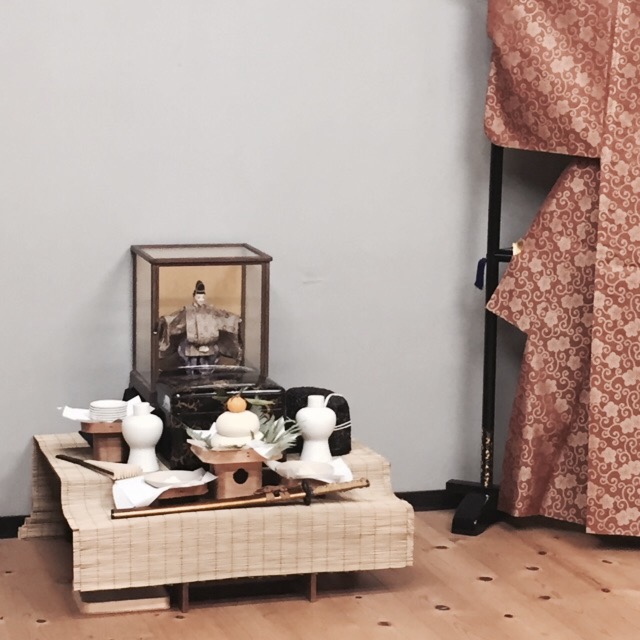
On Sunday 26 April 2015 Udaka Michishige will perform the Noh Oshio, a piece not frequently put on stage by the Kongo School. The play is attributed to Konparu Zenchiku, and draws from the Tales of Ise and from the poetry collection Kokinshu. The main character is in fact the celebrated Heian period poet Ariwara no Narihira (825-880), a central character in other Noh plays, such as the third category (women Noh) plays Kakitsubata and Izutsu. However in Oshio Narihira appears as himself – first as an old man, and later in his original garb, as a Heian period courtier.
26 April 2015 (Sun) from 13:30. Noh: Oshio – Udaka Michishige. Kongo Noh Theatre. Kyoto.
Ariwara no Narihira in a painting by Kano Tanyu
Oshiosynopsis by Rebecca Teele
A Man goes with his Companions to Mt. Oshio having heard that the cherry blossoms are in full bloom there. Among the many flower viewers is an Old Man carrying a branch of blossoms. The Men speak with him and are impressed by his elegant expression of appreciation for the blossoms. He quotes poems by Ariwara no Narihira (825-880) nobleman and courtier, in particular one relating to the visit to the area by the Empress of the Second Ward, Fujiwara no Koshi, who was secretly his lover for a time. The poem reads: Ohara ya, Oshio no yama mo, kyo koso wa, kamiyo no koto mo, Omoiizurame and is translated by Helen McCullough in Tales of Ise as: “On this auspicious day, the divinity of Mt. Oshio at Ohara, will surely remember, what happened long ago, in the Age of the Gods.” The Old Man is, in fact, the spirit of the ‘Man of Old’, the poet Ariwara no Narihira in a transformed state. Later he appears in his true form in a blossom decorated ox cart and dances, remembering incidents of the past and praising the beauty of the cherry blossoms.
For more information on the performance, or to reserve a ticket contact the INI.
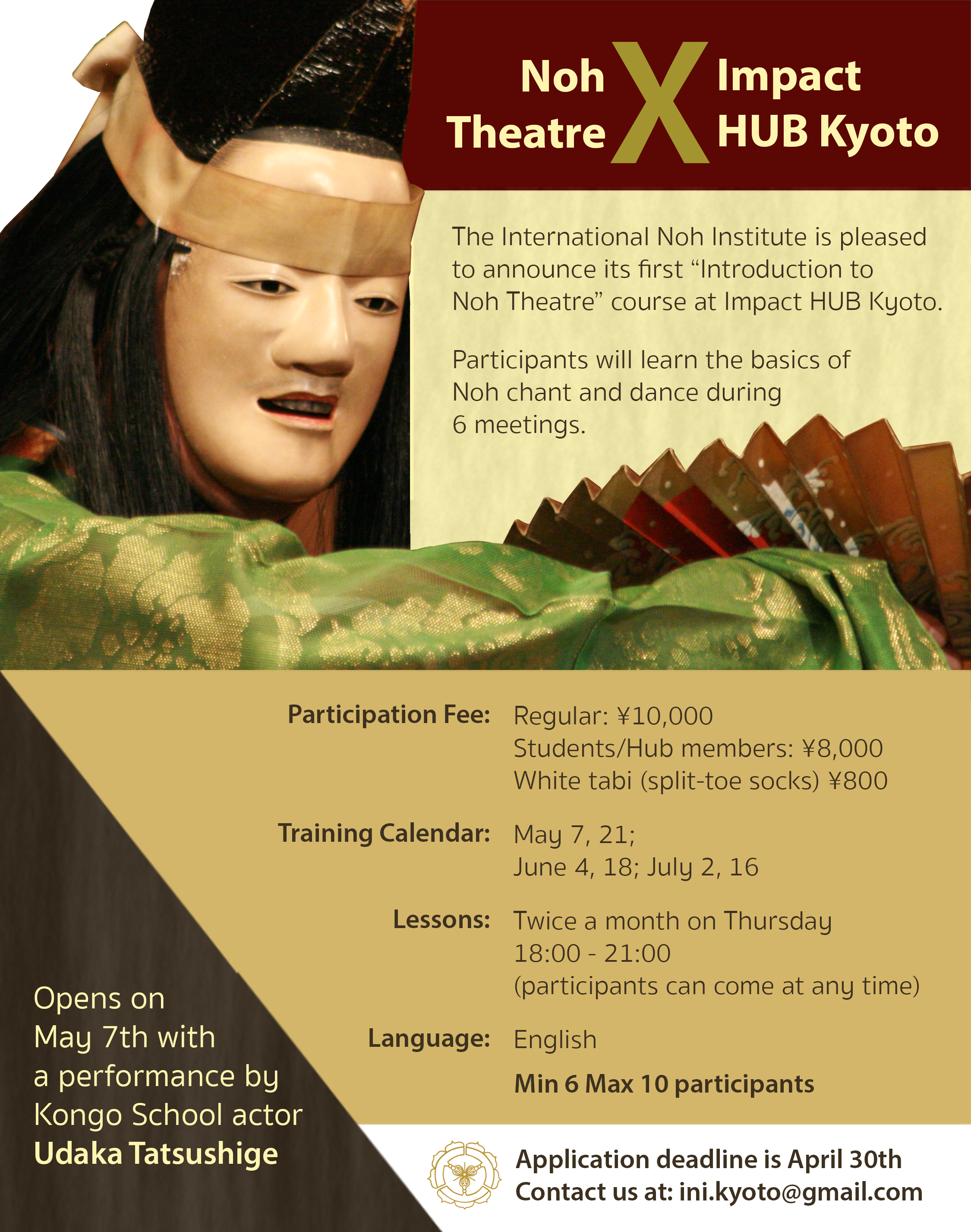
The INI International Noh Institute is pleased to announce the first ‘Introduction to Noh theatre’ course at Impact HUB Kyoto. This 6-session course is aimed at Kyoto residents, exchange students, or any other English-speaker who would like to take a closer look at Noh theatre’s tradition. Participants will learn the basics of Noh chant and dance directly from certified INI instructors. Additional activities include observation of a Noh mask carving workshop and visits to the Noh theatre. Professional Noh actor Udaka Tatsushige will give a performance demonstration on the first session, May 7th.
Practice sessions will take place at Impact HUB Kyoto, a platform promoting innovative thinking and collaborative work, located in a beautiful traditional building in the heart of Kyoto. See below for access information. The lessons will be held in English and no previous knowledge is required: anyone can join!
Dates and time: Twice a month on Thursdays, from 18:00 to 21:00 (participants are free to come and go at any time). Training calendar: May 7, 21; June 4, 18; July 2, 16. Min 6 Max 10 participants.
Participation Fee: Regular: 10,000; Students/Hub members: 8,000 White tabi (split-toe socks) 800yen.
Application: deadline April 30th Feel free to contact us to place your booking or for any other query ini.kyoto@gmail.com
Access: Impact HUB Kyoto Get off at Kuramaguchi station on Subway Karasuma line. Take Exit 1, then walk south (toward Doshisha university) for few minutes (located between Tabacco store and a parking lot).
On 14 March 2015 Udaka Tatsushige (first son of the INI founder Udaka Michishige) will hold the first Tatsushige no Kai, an annual Noh performance event he is producing, featuring high-caliber actors and musicians. Each year Tatsushige is going to take the main role in a particularly challenging play from the Kongo school repertoire. On the occasion of this first Tatsushige no Kai, Kongo Hisanori, grand-master of the Kongo School, has chosen for him the virtuoso Noh playMochizuki. Family tickets and ‘next generation’ tickets for students and Noh theatre beginners are available! Check out the full program in English here!
Mochizuki: March 14th 2015, 14:00-17:00 – Kongo Noh Theatre, Kyoto
Mochizuki: the story
Mochizuki tells a story of revenge, celebrated in classical Japanese literature as an example of loyalty and selflessness in the face of injustice. Lord Tomoharu was assassinated by his cousin Mochizuki, who took over his land and property. In fear for their lives, Tomoharu’s retainers scattered and his wife and son fled their home. When the play begins thirteen years have passed, and now one of the retainers, Tomofusa, is the innkeeper of the Helmet Lodge in the post town of Moriyama. One day two guests, a mother and son, appear without any servants. Tomofusa recognises them as the wife of his master and their son, Hanawaka. At the same time, Mochizuki, the killer, is on his way back from the capital, stops at the Helmet Lodge. Tomofusa recognises him and, together with the wife and son, plots to avenge their master. Mother and son pretend to be entertainers and, together with Tomofusa, they dance for Mochizuki as they pour him copious amounts of wine. Mochizuki is lulled by the wine and the wonderful dances so that he doesn’t realize what is happening when Hanawaka and Tomofusa approach him. They declare their identities and strike him down, finally avenging Tomoharu’s murder and restoring his properties to his family. (Story Outline by Rebecca Teele Ogamo).
What is so special about Mochizuki?
A Meiji-period colour photograph of the shite ready to perform the ‘lion dance’. Note the two golden fans on the head, simbolizing the lion’s jaws (From Albert Kahn’s ‘Archives of the Planet’).
Mochizuki follows the conventions of the ‘genzai-mono’ or ‘real world’ category, meaning that the all the action unfolds on the stage before our eyes chronologically, and all characters are human beings, as opposed to other Noh plays where characters are often spirits or ghosts travelling in space and time. It is a less ‘abstract’ and much more ‘theatrical’ in a western sense, Noh play.
While supernatural beings are represented by masks, the Noh conventions require that human beings who are alive at the moment of the dramatic actions are performed without a mask. Although a mask is not used, the shite is required to maintain a completely expressionless face: actors rely on their movement and ‘presence’ to convey the emotions of the character they represent.
The role of Tomoharu’s son is performed by a child actor. Pre-pubescent children can be seen on the Noh stage portraying top-ranking nobles (such as emperors, or the general Minamoto no Yoshitsune). However in other cases they take the role of normal children, as in the case of Mochizuki, where the son of performs a dance in which he mimes the striking of a little drum at his waist.
After the child has entertained Mochizuki with his dance, it is Tomofusa’s turn. He performs a special version of the shishi-mai, the famous lion dance that can be seen in the Noh Shakkyo.Shishi-mai, or lion dances, were brought to Japan from China and gradually incorporated into the performance rituals of shrines and temples, finally finding their way into Noh drama as well. However, while in Shakkyo the character of the shite actually is the mythical lion that is the attendant of Monju, bodhisattva of wisdom, appearing on the stone bridge leading to his Western Paradise and found frolicking among the ponies there, in Mochizuki the shite is a human being who, within the frame of the ‘real world category’ play, performs a lion dance. He wears a beautiful brocade robe, a red wig, a red cloth that partly conceals his face, and a headpiece with two golden fans spread open, symbolising the lion’s jaws. This type of ‘performance within the performance’ creates an interesting game of mirrors, which is even more meaningful if one thinks that the shishi-mai is a celebratory dance.
In the trailer below you can have a taste of how the dramatic entrance of the shite on the notes of the lion dance.
Mochizuki: March 14th 2015
Make sure to check out the Tatsushige no Kai website (in English) for more information on the performance and for ticket reservation. The Tatsushige no Kai has made special arrangements such as family seats, ‘next-generation seats’, and a child nursing service. An English translation and synopsis of the play will be available. There will be a reception with light refreshments served in the lobby after the performance. If your time permits, please join us for a chat.
FULL PROGRAM
Greeting
Iccho (Shoulder drum and Chant) Eguchi
Shimai (Dance excerpt) Kasa no Dan
Kyogen (Short Comic play) Kagyu (‘The Snail’)
Noh Mochizuki
TIME
Saturday, 14th March. 2015 14:00-17:00 p.m. (doors open at 13:30)
PLACE
The Kongo Noh Theatre
Nakadachiuri-agaru, Karasuma-dori, Kamigyo-ku, Kyoto. 602-0912.
Subway Karasuma-Imadegawa (K06), South Exit (n.6). Walk South 300m. MAP >>
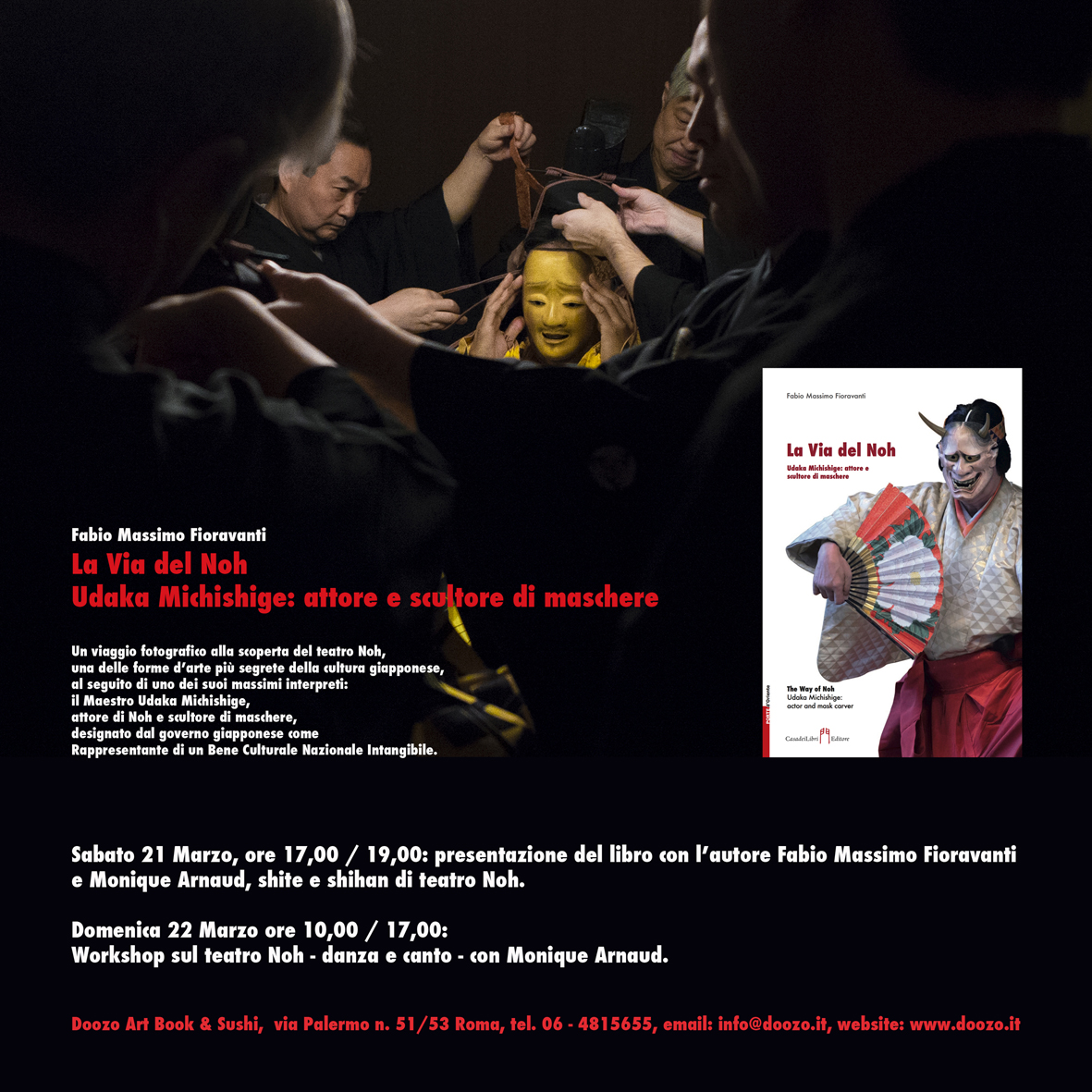
Segnaliamo due eventi sul Noh a Roma a cui prendera’ parte Monique Arnaud, rappresentante di INI per l’Italia.
Sabato 21 marzo
ore 17:00-19:00
Presentazione del libro La Via del Noh Udaka Michishige: attore e scultore di maschere di Fabio Massimo Fioravanti, CasadeiLibri Editore. Intervengono Fabio Massimo Fioravanti (l’autore) e Monique Arnaud (shite e shihan della scuola Kongō) Ingresso libero fino a esaurimento posti.
Domenica 22 marzo
ore 10:00-17:00
Workshop di teatro Noh – danza e canto, con Monique Arnaud.
We would like to draw your attention on two Noh-related events in Rome, featuring INI representative Monique Arnaud.
Saturday 21 March
17:00-19:00
Book launch of the photo book The Way of Noh: Udaka Michishige, actor and mask carver by Fabio Massimo Fioravanti, CasadeiLibri press. Featuring Fabio Massimo Fioravanti (photographer) and Monique Arnaud (Kongō school instructor) Free entry – while seats last
Sunday 22 March
10:00-17:00
Noh workshop – dance and chant, with Monique Arnaud.
Happy New Year from the International Noh Institute!
Two events free of charge will be held in Kyoto as part of the new year celebrations tomorrow January 3rd 2015.
The day will start off with the ritual performance Okina at Yasaka-Jinja from 09:00, featuring will the Iemoto Kongō Hisanori and other members of the Kongō school. Later from 12:00 the ritual recitation of Okina, followed by shimai and maibayashi dance excerpts will be performed at the Kongō Noh Theatre.
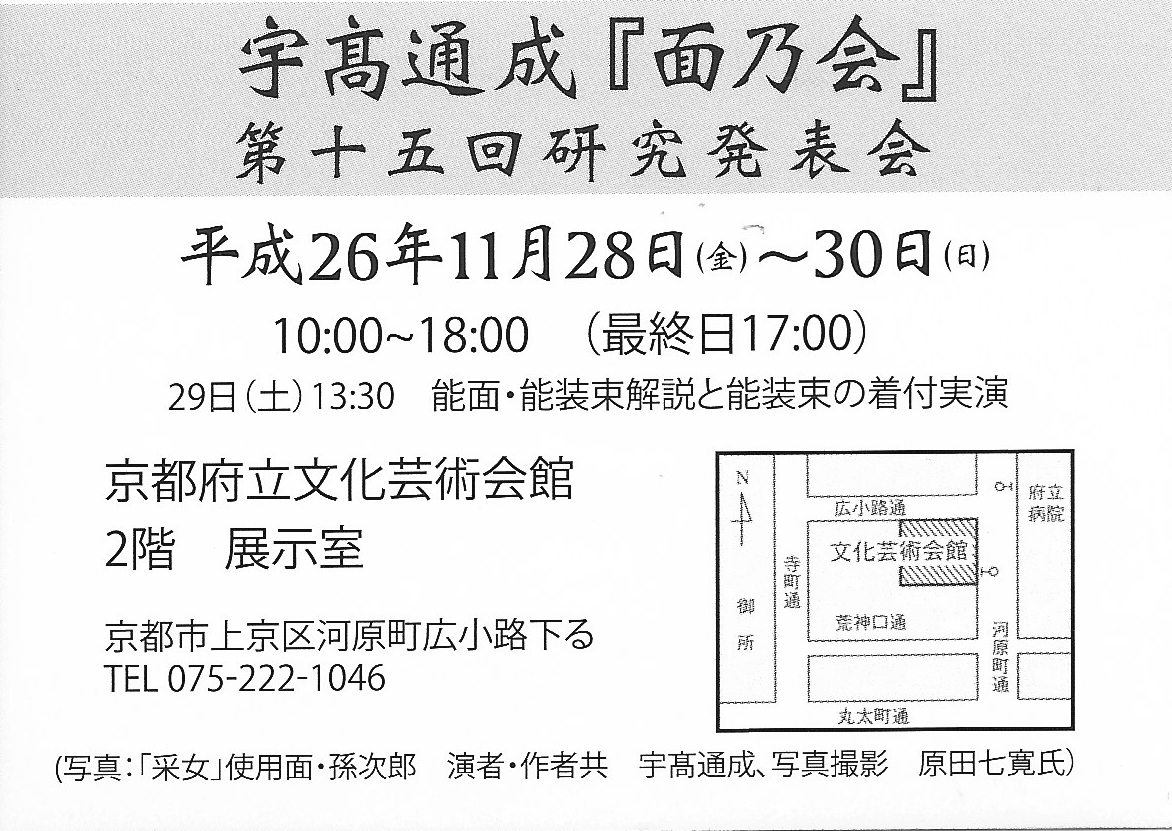
This year’s Men-no-kai Noh mask carving exhibition took place at the Kyoto Prefectural Center for Arts and Culture 28th-30th November. Among others three INI members, INI Senior Director Rebecca Teele Ogamo (USA), Kim Hea-Kyoung (South Korea), and Elaine Czech (USA) exhibited their latest works.
Czech carved a Ko-omote, one of the most popular Noh masks. It is also the first Noh masks that is carved by beginners. Despite its apparent simplicity, the Ko-omote is a very difficult mask to create, and mask carvers often go back to carving it later in their mastery. Ko-omote (lit. ‘small face’) is used for main or secondary roles when the character is a young girl or, in some cases, a supernatural being. Ko-omote is inspired by the aesthetic canons of the Heian period (794-1185), regarded as a golden-age of cultural sophistication and refinement. The face is painted in white, eyebrows are plucked and painted on the top of the forehead, hair is neatly combed on the sides, and teeth are dyed in black. The general feeling is that of innocent beauty.
Kim carved a Zō-onna, used for roles such as the celestial maiden of Hagoromo. As you can see from the picture, this mask shares formal similarities with Ko-omote, though it represents a more mature female visage. For example, eyebrows are thinner, the cheeks less round, and the hair on combed on the side are arranged in a different way. The ineffable beauty of this mask is more suitable for representing supernatural beings and goddesses rather than humans.
Teele Ogamo carved a Kasshiki, a mask used for roles of young temple acolyte such as in the plays Jinen-koji or Kagetsu. The bangs on the forehead represent hair that is yet to be cut before becoming a fully ordained monk. This mask is a blend of masculine features, such as the slightly bushy, pointed eyebrows, and feminine features, such as the hair combed on the sides of the face, creating an overall effect of youthful charm.
In the hi-res pictures below you can compare masks and observe details of the painting and brushing techniques that give an impression of age. Check more pictures of the event, including a costume demonstration, on our Facebook page!
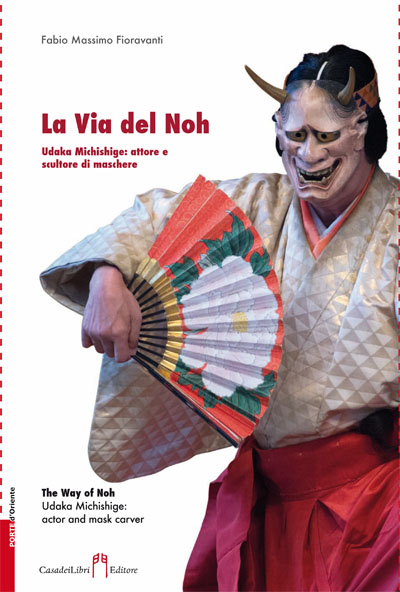
Italian photographer Fabio Massimo Fioravanti presents his photo book The Way of Noh – Udaka Michishige: Actor and Mask Carver on December 4th 2014 in Rome.
The book contains stage and backstage photographs of Kongō School Master-Actor Udaka Michishige, as well as of his Noh masks. The bilingual (Italian-English) book is already available in Italy and will soon be available on the international market, so stay tuned! The event will take place at the Spazio Ducrot gallery, in the heart of Rome, Via d’Ascanio 8/9 on December 4th (Thu) from 19:00, and will feature an exhibition of Fioravanti’s photographs, as well as a Noh mask demonstration by Kongō School certified instructor Monique Arnaud, who also serves as European Coordinator of the INI International Noh Institute. The INI is particularly active in Italy, where Arnaud is teaching Noh chant and dance on a regular basis. INI Italian members Cristina Picelli and Diego Pellecchia, who have now appeared a number of times on Japanese Noh stages, began their training with Arnaud in Milan. If you are in the area do not miss this chance to hear about Fioravanti’s experience with Noh photography, and to meet Noh instructor Monique Arnaud. Ciao!
Here are a few pictures of the 30th Matsuyama Shimin Noh recital in Matsuyama (Ehime pref.). Every year on November 3rd Kei’un-kai and INI members perform shimai (dance) and utai (chant) excerpts in a recital that takes place before a full Noh performance starring Udaka Michishige or, as in this year’s case, his sons Udaka Tatsushige and Udaka Norishige. The Udaka family has its roots in Matsuyama, where its ancestors were Noh performers who served the Matsudaira lords at Matsuyama Castle until the end of the Edo period, hence the deep connection between the current Udaka family, based in Kyoto, and the city of Matsuyama.
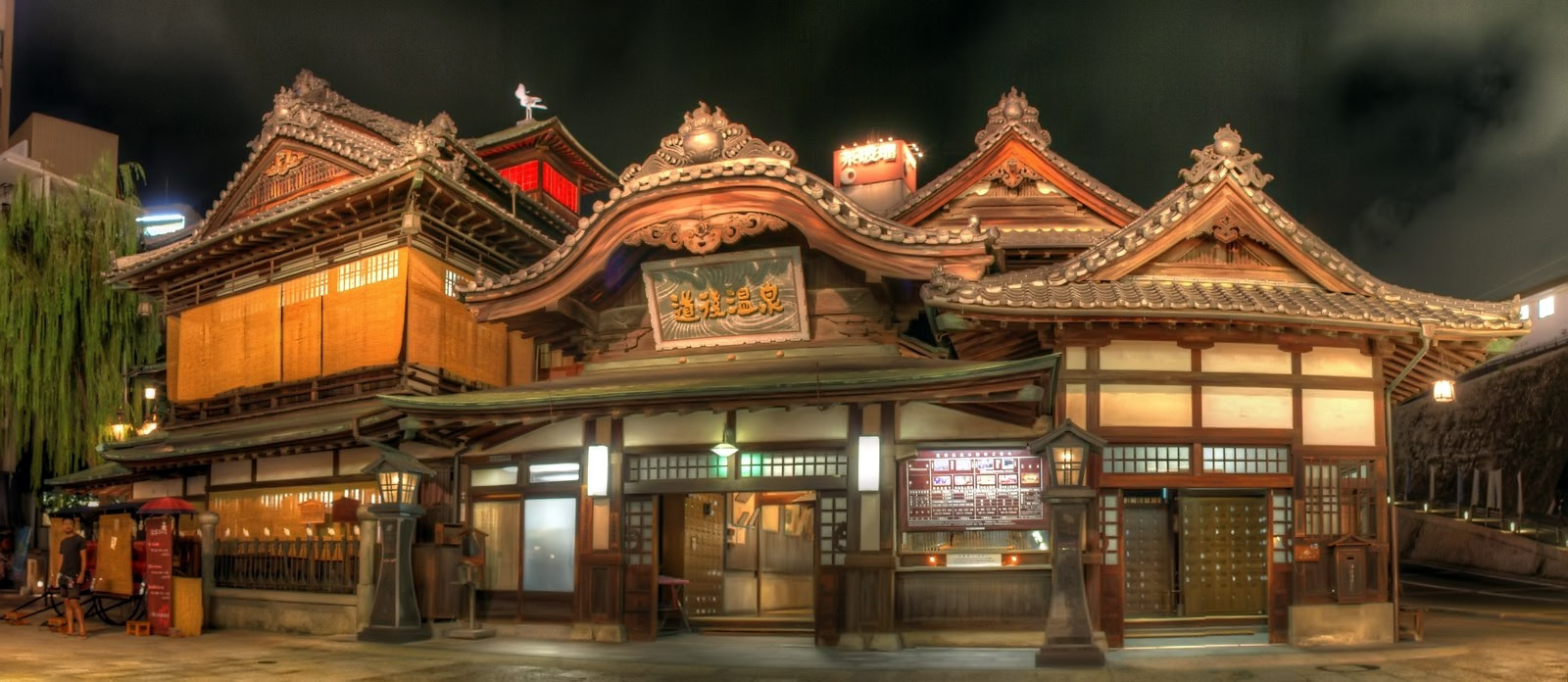
This year’s recital took place at the Dogo Yamatoya Honten, a beautiful ryokan (traditional hotel). The owner of this establishment is a fan of Noh, and the hotel rooms and facilities have Noh-sounding names. On the fourth floor there is an outdoor Noh stage where performances can be watched both from the usual front and side floors, and from porch-like structures at the back of both sides, just like the stages built within the premises of aristocratic mansions or temples. We were blessed by a deep blue sky and crisp autumn air, and the event, culminating with the performances of Takasagomaibayashi by Udaka Norishige and Midare by Udaka Tatsushige, went very well.
Dogo Onsen by frenchbear @deviantart
Elaine Czech and I (Diego Pellecchia) arrived early in the morning on a night bus (a good way to save some money on transportation/accommodation fees) and enjoyed a hot bath at Dogo Onsen, one of the most famous Onsen in Japan, which has also served as model for Miyazaki Hayao’s Spirited Away. Matsuyama is famous for various literary figures and fictional characters who populated it, such as Natsume Sōseki’s Bocchan. Preparations for the performance started early, with more than 30 participants changing into traditional clothes (montsuki/kimono and hakama), getting ready to go on stage. Visitors and audience members could also admire some of Udaka MIchishige’s masks on display in the lobby (see photos below) and watch the recital before the main event, the performances of Takasago and Midare in the afternoon. Elaine has taken pictures from of the day, which we are sharing here. Enjoy and we hope to see you there next time!
Udaka Michishige’s calligraphy
Shintai, Zo-Onna, Magojiro masks by Udaka Michishige
Udaka Michishige is unique in being both a shite actor of the Kongo School, and a Noh mask carver. This year’s Noh mask exhibition of the Men-no-kai, his group of students from Tokyo, Nagoya and Kyoto studying Noh mask carving will take place at the Kyoto Prefectural Center for Arts and Culture on Hirokoji-Kawaramachi dori, second floor, November 28th – 30th, from 10:00 to 18:00 (closes at 17:00 on the 30th). On November 29th (Sat.) from 13:30 there will be an explanation and a demonstration of the elaborate costuming of a Noh actor.
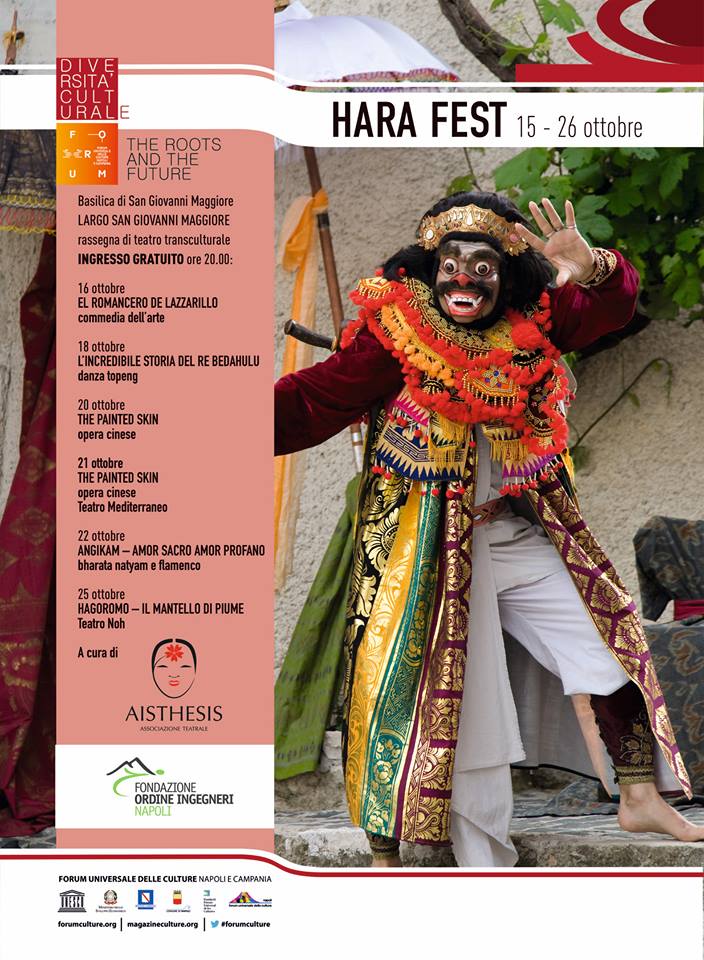
On 25 October 2014 at the Basilica di San Giovanni Maggiore in Naples the Italian branch of the International Noh Institute will perform a reduction from the NohHagoromo (‘The Robe of Feathers’) at Hara Fest, an Asian theatre festival organised by Aisthesis and the Forum Universale delle Culture. Naples has a long-standing tradition of cultural-exchanges with Asia. The famous Orientale University hosts one of Italy’s major centres for Japanese studies.
On the same day, from 10:00 to 13:00 and from 14:00 to 18:00 Kongo School licensed instructor Monique Arnaud will also hold a Noh workshop at Teatri 35, Largo Proprio di Arianiello 12, 80138 Naples, Italy.