Tag Archives: Kyoto

INI summer training 2015 – introducing Sadia Gordon

Dear INI members and supporters, greetings from an unusually fresh Kyoto! It’s Diego here. While the temperature might be lower than usual, we are looking forward to a hot summer full of events and training opportunities here at the INI headquarters. Many international students are going to join the INI summer training, and we would like to give them a chance to introduce themselves and explain why they chose to study Noh with the INI. I always enjoy learning how different paths and life experiences can lead to the study of Noh theatre. So here is our first guest, Sadia Gordon, sharing her first impression of the INI Noh training in Kyoto.


Konnichiwa!

Sadia Headshots-7878

Sadia Gordon (New Zealand)

My name is Sadia Gordon. I am a 22 year old actor in training, studying Performing and Screen Arts at Unitec in Auckland, New Zealand. In our third and final year of study, we are given six weeks to go out and explore something that we are interested in, connected with the field of work we would like to go into. At Unitec, we are lucky enough to have John Davies as our Head of Department. John has been to Japan on several occasions to study Noh Theatre.

In my first year at drama school, John did a small performance of a Noh Theatre play in full costume with the wig and mask. I remember being amazed by his stillness and precision, and thinking that would be something I would find very hard to do. I had been thinking about what I wanted to explore for secondment, in terms of what my main challenges are as an actor and what would help me get to the place I want to be before graduating.

This idea of feeling completely grounded and connecting with the breath has been something that I have found hard throughout my acting training. However, I have found that when I do reach this calm, centred place, my thoughts are so much clearer on stage and I can really tune into the intentions of my character. During a meditation class, led by John, I suddenly felt completely connected to myself, without any outside noise distracting me. I realised this is the direction I need to go in. I knew that Noh Theatre would be a way for me to further develop my stage presence while also connecting with myself and my base. I thought that learning Noh in Japan would be the ultimate way to immerse myself in the culture and really get to understand the art form. I worked 12 hour shifts for 3 long months at a vegetable factory in Christchurch, New Zealand to save up and I am now seeing how worth it that was!
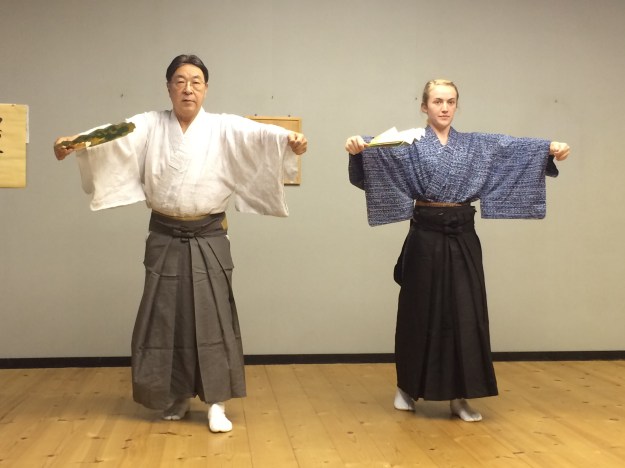
Udaka Michishige and Sadia Gordon

Udaka Michishige and Sadia Gordon

Japan is very different from New Zealand, but I also see some similarities which make me feel like I am at home. Kyoto is such a beautiful, fresh place. I feel very calm and safe here. I have found people to be so kind and generous and interested in what I have to say, which I think can be very rare these days. I can’t believe that I am surrounded by beautiful temples and I can go and sit in any one of them, for as long as I want to. I feel so lucky that I am able to be here, working under Udaka Michishige’s tuition, as John did years ago.

My first Okeiko was incredible. I was very nervous, but as soon as I stood up on the butai with my tabi on, I could feel my feet firmly on the ground and I felt very at ease, within the structure of my movements.  I hope that in 5 weeks, when it comes time for me to go back home, I can take with me some of the beauty and simplicity of traditional life here. I am realising how important and healthy it is for us to take time out of our busy lifestyles, full of noise and technology to sit and listen.

Domo Arigato Gozaimasu.

Sadia Gordon

Kongo Monthly Noh 26 April 2015 – ‘Oshio’

On Sunday 26 April 2015 Udaka Michishige will perform the Noh Oshio, a piece not frequently put on stage by the Kongo School. The play is attributed to Konparu Zenchiku, and draws from the Tales of Ise and from the poetry collection Kokinshu. The main character is in fact the celebrated Heian period poet Ariwara no Narihira (825-880), a central character in other Noh plays, such as the third category (women Noh) plays Kakitsubata and Izutsu. However in Oshio Narihira appears as himself – first as an old man, and later in his original garb, as a Heian period courtier.

26 April 2015 (Sun) from 13:30. Noh: Oshio – Udaka Michishige. Kongo Noh Theatre. Kyoto.

Ariwara no Narihira in a painting by Kano Tanyu

Oshio synopsis by Rebecca Teele

A Man goes with his Companions to Mt. Oshio having heard that the cherry blossoms are in full bloom there. Among the many flower viewers is an Old Man carrying a branch of blossoms. The Men speak with him and are impressed by his elegant expression of appreciation for the blossoms. He quotes poems by Ariwara no Narihira (825-880) nobleman and courtier, in particular one relating to the visit to the area by the Empress of the Second Ward, Fujiwara no Koshi, who was secretly his lover for a time. The poem reads: Ohara ya, Oshio no yama mo, kyo koso wa, kamiyo no koto mo, Omoiizurame and is translated by Helen McCullough in Tales of Ise as: “On this auspicious day, the divinity of Mt. Oshio at Ohara, will surely remember, what happened long ago, in the Age of the Gods.” The Old Man is, in fact, the spirit of the ‘Man of Old’, the poet Ariwara no Narihira in a transformed state. Later he appears in his true form in a blossom decorated ox cart and dances, remembering incidents of the past and praising the beauty of the cherry blossoms.

For more information on the performance, or to reserve a ticket contact the INI.

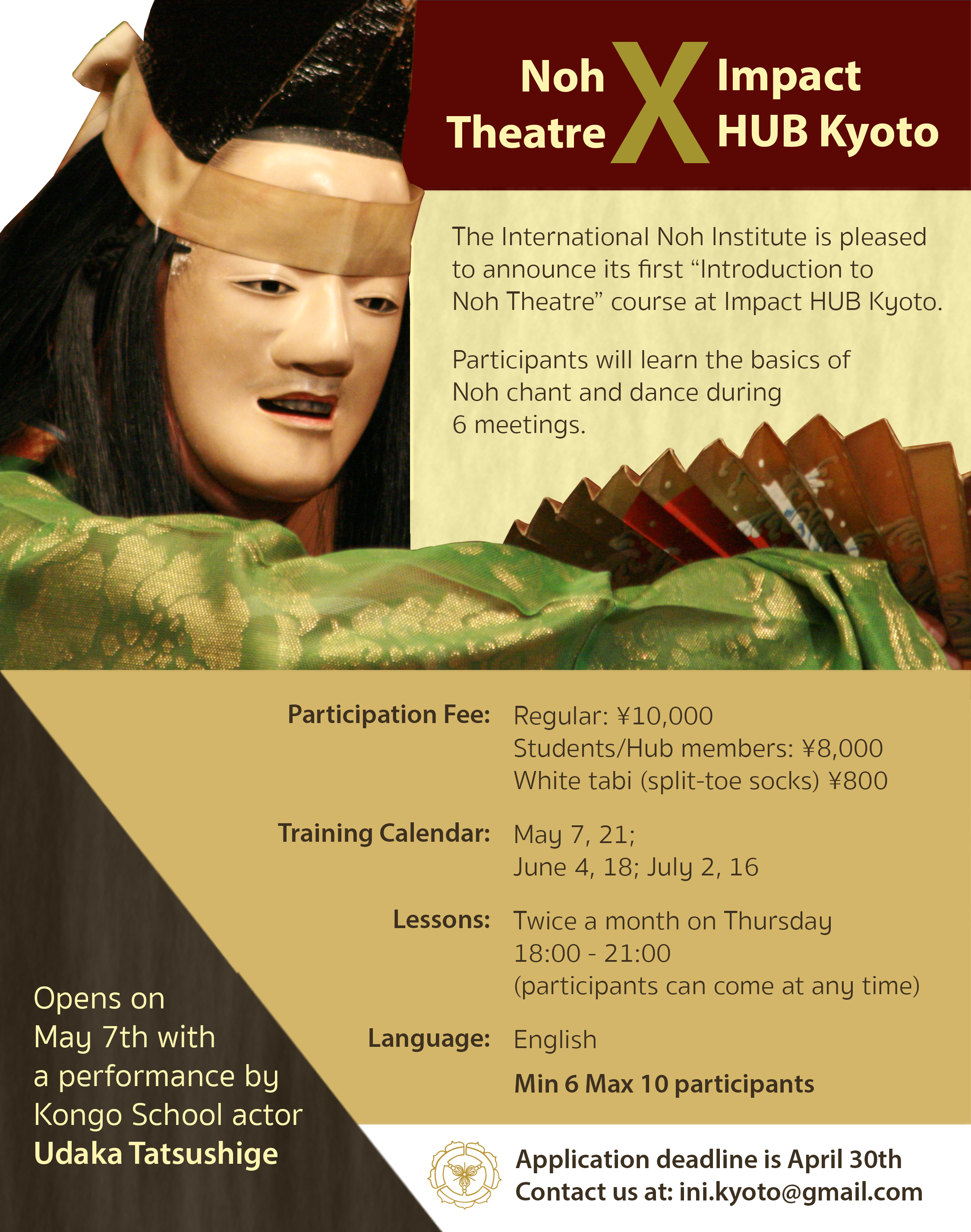
Noh theatre X Impact HUB Kyoto

The INI International Noh Institute is pleased to announce the first ‘Introduction to Noh theatre’ course at Impact HUB Kyoto. This 6-session course is aimed at Kyoto residents, exchange students, or any other English-speaker who would like to take a closer look at Noh theatre’s tradition. Participants will learn the basics of Noh chant and dance directly from certified INI instructors. Additional activities include observation of a Noh mask carving workshop and visits to the Noh theatre. Professional Noh actor Udaka Tatsushige will give a performance demonstration on the first session, May 7th. 

Practice sessions will take place at Impact HUB Kyoto, a platform promoting innovative thinking and collaborative work, located in a beautiful traditional building in the heart of Kyoto. See below for access information. The lessons will be held in English and no previous knowledge is required: anyone can join!

Dates and time: Twice a month on Thursdays, from 18:00 to 21:00 (participants are free to come and go at any time). Training calendar: May 7, 21; June 4, 18; July 2, 16. Min 6 Max 10 participants.

Participation Fee: Regular: 10,000; Students/Hub members: 8,000 White tabi (split-toe socks) 800yen.

Application: deadline April 30th Feel free to contact us to place your booking or for any other query ini.kyoto@gmail.com

INIXHUB 2015 web

Access: Impact HUB Kyoto Get off at Kuramaguchi station on Subway Karasuma line. Take Exit 1, then walk south (toward Doshisha university) for few minutes (located between Tabacco store and a parking lot).

Pictures from the Noh workshop at Iori Machiya

On Friday 20th November 2014 the INI held a Noh workshop for a group of twelve American visitors led by Bob Stigler, co-president of the Washington-based educational organisation New Stories. It has been a memorable day because Bob and Michishige first met some 40 years ago in Kyoto, but have not seen each other ever since. It has been particularly enjoyable to listen them sharing memories of the old days in Kyoto, and impress each other with their achievements! Udaka Michishige lead the workshop along with his sons Tatsushige and Norishige. Diego Pellecchia has helped interpreting for the participants and Elaine Czech took pictures. The workshop took place at Iori, a luxurious Kyoto-style machiya (traditional townhouse) we use regularly for our event.

As you can see in the photographs, Tatsushige and his father showed and explained the features of a number Michishige’s Noh masks. Speaking of masks, The Udaka Men-no-kai exhibition is coming up soon: don’t miss the chance to see some of these masks live if you are in Kyoto on on 28-29-30 November! Participants could also admire (and try on!) precious Noh costumes, as well as experience basic Noh movement techniques. Bob’s group has been a lovely audience – thank you so much! Everyone expressed much gratitude to Udaka Michishige and to the INI, and some participants decided to stay longer in Kyoto in order to see the Kongo school monthly performance coming up this Sunday 23rd at the Kongo Noh theatre, featuring the Noh Ikkaku sennin (‘The One-Horned Hermit’ which you can see in the picture below!).

Noh Photography #2 Stéphane Barbery

Here is the second of a series of posts on photographers who have worked with the INI and with Udaka Michishige. (See the first post of the series, featuring Irwin Wong). This time we have asked Stéphane Barbery to contribute to our blog with his thoughts on photographing Noh. Stéphane is a French writer and photographer living in Kyoto, where he studies traditional arts since 2008. He is currently working on a ten-year book project on Japanese beauty. Stéphane is a regular Noh theatregoer, and has taken pictures of a great number of Noh performances, as well as other performing arts. His personal take on Noh is apparent in the stunning pictures that capture the intensity of performance moments. We have met Stéphane on a number of occasions in Kyoto, and have always been impressed by his passion for Noh and determination to disseminate it internationally. Find out about Stéphane’s many activities on his blog and his Flickr page.


I consider Noh as an atheist religious experience. It is not “just an(other) exotic entertainment”. Noh is the most noble and intense form of collective trance that I know. It purifies the heart and restores faith in the kindhearted nature of human beings. The photographer must thus take all the necessary steps to preserve the masters and the sense of trance in the audience. This means :

1) Being invisible.

a) Avoid strobes or added lightings.

b) Staying usually in the back of the room which implies using a long zoom. I’ve discovered that the equivalent of a full frame 600mm is necessary in order to take pictures that are framed enough so that the non-acting people on stage (specially the musicians and the koken stage assistants) do not show on the background of a picture creating a visual noise that dilutes the emotion of a movement that usually relies on a detail in a fraction of a second. I also want to avoid “static” pictures that, from my point of view, lose all the specific dynamic energy of Noh. It means that I take a lot of pictures and carefully select the most intense ones during the processing phase.

2) Being absolutely silent. Technology (specially after Panasonic Gx7) allows to take pictures in total “silent mode” with no shutter or lens motor sounds.

B) Photographers should never aim for verisimilitude but should try to share the peak of  the emotions they felt. During the development of pictures (nowadays, with digital photography, on a computer using Adobe Lightroom), they should feel totally free to modify every parameter of the shot (colour, contrast, lighting, frame, etc.) in order to convey the intensity of what they saw. If the colours of his file, considering the limits imposed by the effort to be ‘invisible’, can be mixed in a noise that does not honor the genius of the colours and patterns displayed on a Noh stage, then it is best to shift to monochrome in order to underline the detail they want to share.

C) The exceptional nature of Noh is not only seen during the short time of the stage but also in the lifetime preparation process of the Noh performers. My dream is to be able to take pictures of all the dimensions of this “behind the scenes” world so that those who cannot get the chance to access it can understand the number of skills required to be a Noh master, but also how intensively those professionals are dedicated to their art. As such they are true sources of inspiration who deserve to be much more honoured than they are nowadays.

Stéphane Barbery

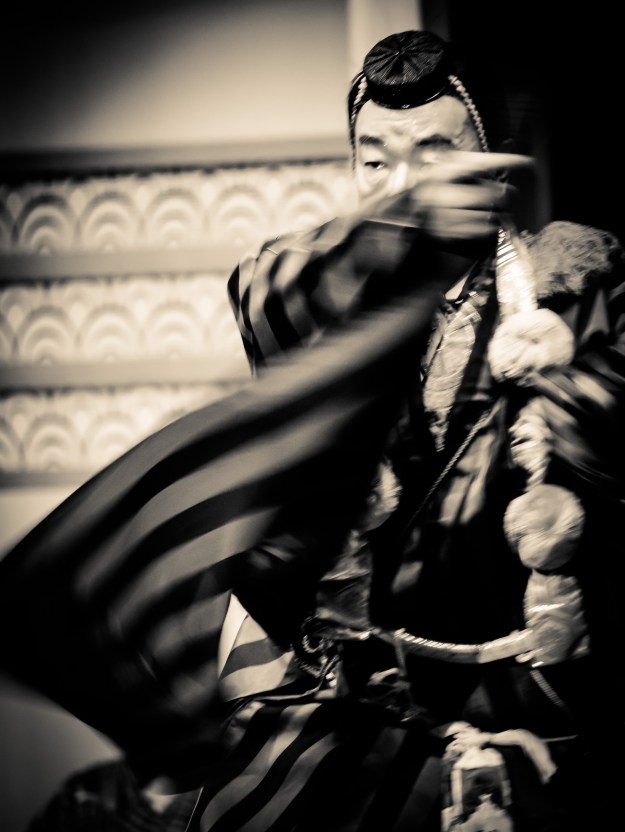
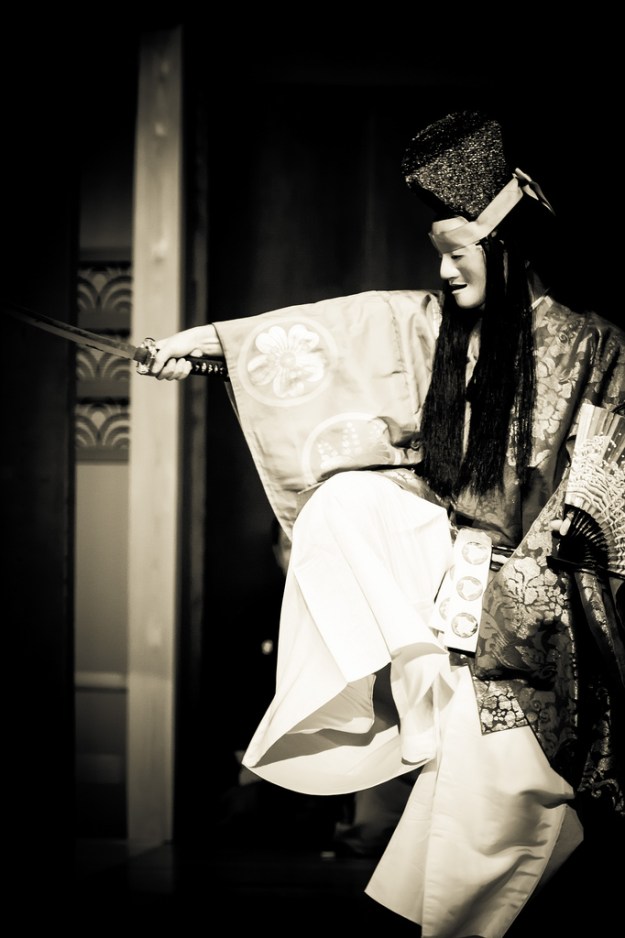
Noh: Ataka. Shite: Udaka MIchishige. Photo: Stéphane Barbery

Noh: Ataka. Shite: Udaka MIchishige. Photo: Stéphane Barbery

Noh: Ataka. Shite: Udaka Michishige. Photo: Stéphane Barbery

Noh: Ataka. Shite: Udaka Michishige. Photo: Stéphane Barbery

Noh: Ataka. Shite: Udaka MIchishige. Photo: Stéphane Barbery

Noh: Ataka. Shite: Udaka MIchishige. Photo: Stéphane Barbery

Noh: Hagoromo. Shite: Udaka Tatsushige. Photo: Stéphane Barbery

Noh: Hagoromo. Shite: Udaka Tatsushige. Photo: Stéphane Barbery

Noh: Hagoromo. Shite: Udaka Tatsushige. Photo: Stéphane Barbery

Noh: Hagoromo. Shite: Udaka Tatsushige. Photo: Stéphane Barbery

Diego Pellecchia getting dressed for the rehearsal of the Noh 'Kiyotsune'. Photo: Stéphane Barbery

Diego Pellecchia getting dressed for the rehearsal of the Noh ‘Kiyotsune’. Photo: Stéphane Barbery

The Y-shaped kibane, a wooden piece that sustains the heavy okuchi-wide trousers. Photo: Stéphane Barbery

The Y-shaped kibane, a wooden piece that sustains the heavy okuchi-wide trousers. Photo: Stéphane Barbery

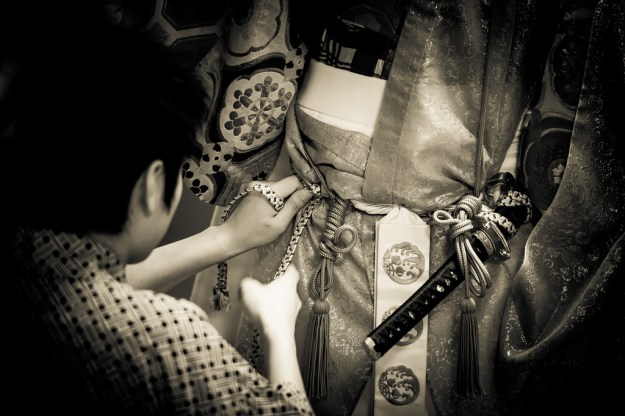
Adjusting the costume for the rehearsal of the Noh 'Kiyotsune'. Photo: Stéphane Barbery

Adjusting the costume for the rehearsal of the Noh ‘Kiyotsune’. Photo: Stéphane Barbery

Diego Pellecchia bowing to the Chujo mask before the rehearsal of the Noh 'Kiyotsune' Photo: Stéphane Barbery

Diego Pellecchia bowing to the Chujo mask before the rehearsal of the Noh ‘Kiyotsune’ Photo: Stéphane Barbery

Noh: 'Kiyotsune'. Shite: Diego Pellecchia. Photo: Stéphane Barbery

Noh: ‘Kiyotsune’. Shite: Diego Pellecchia. Photo: Stéphane Barbery

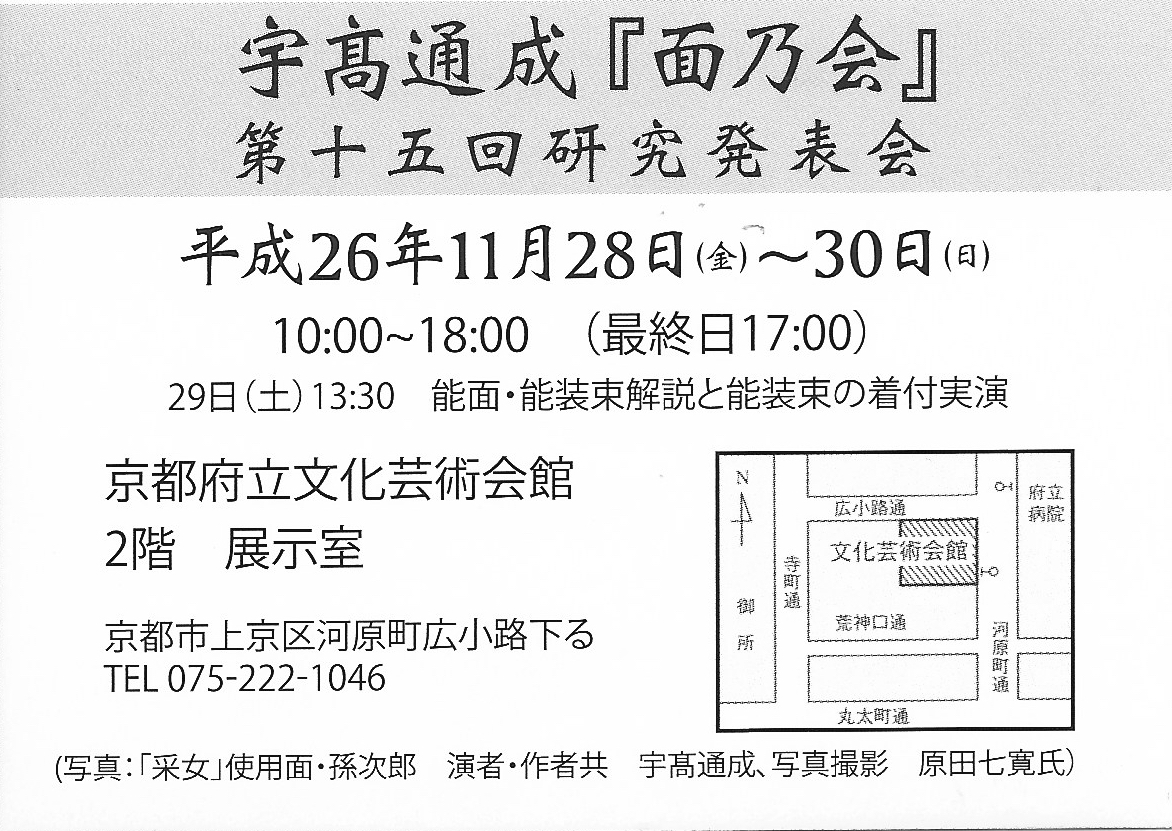
15th Udaka Michishige Men-no-kai Noh mask exhibition

Udaka Michishige is unique in being both a shite actor of the Kongo School, and a Noh mask carver. This year’s Noh mask exhibition of the Men-no-kai, his group of students from Tokyo, Nagoya and Kyoto studying Noh mask carving will take place at the Kyoto Prefectural Center for Arts and Culture on Hirokoji-Kawaramachi dori, second floor, November 28th – 30th, from 10:00 to 18:00 (closes at 17:00 on the 30th). On November 29th (Sat.) from 13:30 there will be an explanation and a demonstration of the elaborate costuming of a Noh actor.

Noh: Uneme. Shite: Udaka Michishige. Mask: Magojiro, by Udaka Michishige. Photograph: Harada Shichikan.

Noh: Uneme. Shite: Udaka Michishige. Mask: Magojiro, by Udaka Michishige. Photograph: Harada Shichikan.

Nomenten back


Learn Noh mask carving from a professional Noh actor

Autumn is finally here! The leaves are turning to beautiful shades of red and gold in the crisp autumn air, and we are getting ready to admire the gorgeous foliage on the hills that surround Kyoto, the ancient capital. In this wonderful and refreshing atmosphere we renew our invitation to visit Udaka Michishige’s Noh mask carving atelier.

Udaka Michishige is unique in being both a Noh actor and a mask carver. Students in his mask carving classes in Kyoto, Nagoya and Tokyo learn to sculpt masks of a high quality that can be used on stage. Every two years a group mask exhibition is held in Kyoto to show the latest results of students efforts. These mask exhibitions include free-standing displays of some masks, performance pictures, costumes and lecture-demonstrations to promote a deeper understanding of the place of the Noh mask in the world of Noh.

Contact us to arrange a visit of Udaka Michishige’s atelier in Kyoto, Nagoya, or Tokyo.

(Poster design by Elaine Czech)

mask_fall_14_final

mask_fall_14_back

Thoughts on the Kei’un-kai Memorial Performance 2014

The program board outside the theatre

On August 17th 2014 The Kei’un-kai Memorial Performance, including INI members, took place at the Kongo Noh Theatre in Kyoto. It was a long day, with shimai, rengin, maibayashi and full Noh plays performed  from dawn to dusk.  This year’s performance took place at the end of the o-bon period in Japan, during which people remember and honour the dead. It was an occasion for us performers and for the audience to express gratitude to those who are not with us anymore.

For this purpose, Udaka Michishige has chosen a poem by Henjo (816-890), quoted in the Noh Sumizome-zakura, ‘The Ink-dyed Cherry Tree’. “Everyone is wearing colourful robes, while my mossy sleeves (a monk’s robes) are yet to dry.” Henjo became a priest after the death of Emperor Nimmyo, and the poem expresses the poet’s grief and his reluctance to return to colourful robes after the official time of mourning, though others around him have done so. Udaka Michishige created a calligraphy with the first line of the poem, which you see on the hanging scroll in the picture below.

Rebecca Teele Ogamo. Calligraphy: Udaka Michishige. Kakejiku hanging scroll: Kim Heakyoung.

 The INI Senior Director, Rebecca Teele Ogamo, would like to share the following thought about the performance: ‘It was very special to remember both those we once performed with us as Keiun-kai or INI members and those who have supported us in the past and I think we all felt their warm presence cheering us on. And perhaps they were in “flowery robes” as they watched with nostalgia our struggle with the nerves and doubts that sometimes clouded our vision’.

The INI would like to thank all those who have participated to this performance, and whose help and support motivates us to continue our study and research of Noh.

Pictures from the INI Noh mask carving/painting hands-on session – July 2014

On July 20th 2014 Udaka Michishige’s Noh mask carving atelier opened its doors to Kyoto residents and exchange students from Japan, Lebanon, France, China, Thailand, and Italy who wished to explore the world of Noh masks. Participants were able manipulate the fragrant hinoki wood, and tools such as saws and chisels, and try their best in the first stages of the carving process. Later they were introduced to the basics of painting, such as application of gofun shell powder and natural pigments. Udaka Michishige explained how the wood is cut respecting the way the tree grows, and provided insights on mask techniques from the point of view of the expert Noh actor, as well as mask carver.

It’s a been a lovely Sunday morning and we look forward to welcoming other participants in the near future!

_MG_0270-7

無料見学と体験:能面の彫りと彩色。Free Noh mask carving/painting hands-on session.

nomen chirashi summer

無料見学と体験:能面の彫りと彩色

26年7月20日(日)午前10時〜12時

場所:宇髙通成『面乃会』京都本部敷舞台 地下鉄国際会館歩:7分・三宅町バス停前 〒606−0047 京都市左京区上高野薩田町111 Googleマップhttp://goo.gl/maps/38RjC

お問い合わせ・お申込:TEL-FAX: (075)761-5639 メール: udakakai@yg7.so-net.ne.jp

動きやすい服装で来て下さい。


FREE Noh mask carving/painting hands-on session

2014 July 20th (Sun) 10:00am-12:00am

@Udaka Michishige ‘Men-no-kai’ Headquarters, Kyoto

Subway: Kokusai-kaikan station, 7 min walk. Bus: Miyake-cho bus stop. 111 Satsuta-cho, Kami-Takano, Sakyo-ku. Kyoto, Japan 606-0047. Google maps: http://goo.gl/maps/38RjC

For information or to reserve a place EMAIL: ogamo-tr@mbox.kyoto-inet.or.jp

Please wear comfortable clothes.