Tag Archives: performance

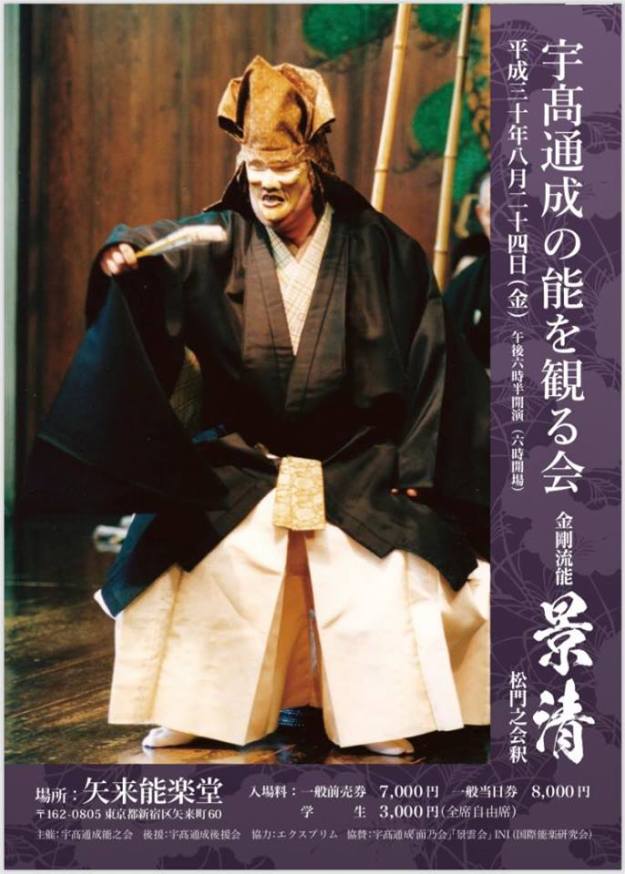
Udaka Michishige to perform noh ‘Kagekiyo’ in Tokyo 24-08-2018

Kagekiyo

performed by

Udaka Michishige

The story:

A young woman called Hitomaru leaves her home in Kamegae near Kamakura to go with an Attendant in search of her father, the Heike warrior Taira-no-Kagekiyo, also known as Akushichibyoe, the ‘Hot-tempered’. It is rumored that he lives in exile in Hyuga, destitute and blind after putting out his own eyes rather than see his clan in defeat. Though she has not seen him since childhood, she hopes to meet him and hear of his life. Hitomaru and her Attendant find a blind man in a poor thatched hut who is, in fact, Kagekiyo, but he pretends not to know who they seek, both out of shame for his present condition and fearing that his daughter will be disgraced. In response to their inquiries, a Villager leads them again to Kagekiyo who at last recognizes his daughter. At the urging of the Villager, Kagekiyo tells his daughter of his role in the Battle of Yashima where he hoped to find and kill the Genji general Minamoto no Yoshitsune, but unable to do so, he attacked Minoya Juro a valiant warrior from Musashi Province, instead. They grappled, but Minoya was able to get away when the neck-piece of his armor broke. His tale finished, Kagekiyo begs Hitomaru to remember him in her prayers and sends her on her way home.

The Tale of the Heike which describes the rise and fall of the Heike clan and its rival, the Minamoto clan (or Taira and Genji clans, depending on the reading of the kanji characters) at the end of the Heian period during the late 12 century, provides material for many Noh plays.

Kagekiyo is unusual in that a child searches for a parent, while in most 4th-category Noh it is a mother who searches for a missing child. The passion and fiery temper of Kagekiyo are undimmed even now that he has fallen in the world, and are clear in his continuing struggle with his feelings as he first rejects, then accepts, his daughter and tells her of his days of glory long ago. There is no historical basis for his blindness or exile, as he was kept a prisoner in Kamakura after surrendering following the failure of an attempt to assassinate the Genji leader Yoritomo.

The shōmon-no-ashirai vartation adds further color to the story of Kagekiyo. The flute accompaniment, or ashirai, before the sashi chant section considered to be of special difficulty, expresses the loneliness and pathos of Kagekiyo’s life.

(Rebecca Ogamo Teele)

Place: Yarai Noh Theatre (Tokyo)

Time: 24 August 2018 (Friday) 18:30-20:00

Tickets: 7,000¥ (advanced sale) 8,000¥ (at the door) 3,000¥ (students)

For tickets or other enquiries: udakakai@yg7.so-net.ne.jp
35236568_994149427429520_8264525694738890752_n.jpg

35347197_994149417429521_7851277406240243712_n.jpg

On the performance of Sagi at the Seiran Noh 2016

We publish here some thoughts on Udaka Michishige’s performance of Sagi (The Heron), by Rebecca Teele Ogamo.

The Seiran Noh performance of Sagi on September 11th, 2016 celebrating Udaka Michishige’s 70th birthday was one of the plays featured in the Kansai area Noh reviews in the Nohgaku Times. As the critic points out, the story is a demonstration of how a bird, without spirit or mind, shows its gratitude towards the emperor and has no real emotional expression. This being the case, the success or failure of a performance rests on the actor’s skills, refined over time, to portray the sense of purity and innocence of the heron through making the face a vehicle of abstract expression, as a mask is not used, but is performed hitamen, or with the face as a mask, or instead of a mask. The critic was especially impressed by the way that Michishige was able to do this, keeping his face completely devoid of expression. His portrayal of the utter stillness of the bird when it stopped, as though perching without moving had a majestic grace, and the seemingly effortless performance of the unique and extremely difficult dance of the heron, meticulously and without any wasted movement, seemed to reveal to the audience the actual heron on the shore of the pond.


michsihige-sagi

Udaka Michishige as ‘the heron’ in Sagi. Udaka Seiran Noh. Kongō Nōgakudō, 11 September 2016. (Photo: Oka Tetsuya)


I have seen Udaka-sensei in other hitamen roles, but always as in the role of a living person, as in Hachinoki or Mochizuki, or of a ghost manifesting as a living person as in the first half of Atsumori. This was the first time to see him in the role of a non-human creature, relying on completely on focused movement, rather than a mask, to portray the essence of the heron. I was startled when I realized that I was no longer aware of an actor or his face, but felt I was watching a heron as it danced. The critic seemed to confirm this experience. “I wonder what kind of Sagi I will be?” Michishige mused one day after a mask carving class. I think it was the natural result of years of dedicated uncompromising practice.

Whatever our path, challenges are limitless, and the base and foundation on which we pursue them must always be a constant refining of basic skills.

For INI, too, this means a continuing renewal of our commitment to sharing and exploring the traditions of Noh. We grow and gain energy through shared experiences of how we test our limits. Please let us know about your path and progress, and know we support you in your challenges.”

Rebecca Teele Ogamo

michishige-sagi-nogaku-times

Photos from the 2016 Kei’un-kai INI Taikai Gala Recital

Fabio Massimo Fioravanti, who has already collaborated with Udaka Michishige on various projects, including the book La Via del Noh – The way of Noh captured these beautiful moment from our last Taikai Gala Recital at the Kongo Noh Theatre on August 21st.

We would like to congratulate all participants – in particular Monica Alcantar, Lisa Swinbanks and Regina Toon, our INI Summer Program graduates! Well done! See you again soon!

INI Summer Intensive Program 2016

The INI – International Noh Institute is now accepting applications for its 2016 Summer Intensive Program. Participants will join INI members for a 2-week intensive training period, during which they will study Noh chant and dance at the INI headquarters in Kyoto with master-actor of the Kongō school, Udaka Michishige. During their stay, participants will be able to learn various aspects of noh, including masks and costumes.

Lessons follow the traditional methods of the Kongō school, providing participants with the unique chance of frequenting the okeikoba, private training space of a noh master, for an immersive experience.

Participants are also welcome to join the August 21st Kei’unkai-INI Gala Recital, along with Udaka Michishige’s international and Japanese students, on the prestigious stage of the Kongō Noh Theatre, in Kyoto.

INI SUMMER INTENSIVE PROGRAM 2016

Requirements: Anyone is welcome to join – no previous knowledge of Noh is required. Lessons are delivered in English and/or Japanese.

Capacity: 5 participants

Place: INI Headquarters, Kyoto

Period: August 1 – 14 2016

Fees (in Japanese yen)

Regular 60,000
Student 40,000
Recital at the Kongo Noh theatre (optional) 20,000
  • Participants are required to purchase separately the necessary personal items for noh practice: tabi white split-toe socks (around 700yen) and a Kongō-style Noh dance fan (5000yen).
  • Participants are required to arrange for their accommodation.

How to apply: send us an email at ini.kyoto[at]gmail.com Please attach your C.V. and a brief statement of interest.

Read impressions of the INI summer training from participants Sadia Gordon and Dorothee Neff.

Images from past events


The Second Tatsushige no Kai: Shoki – 20 March 2016

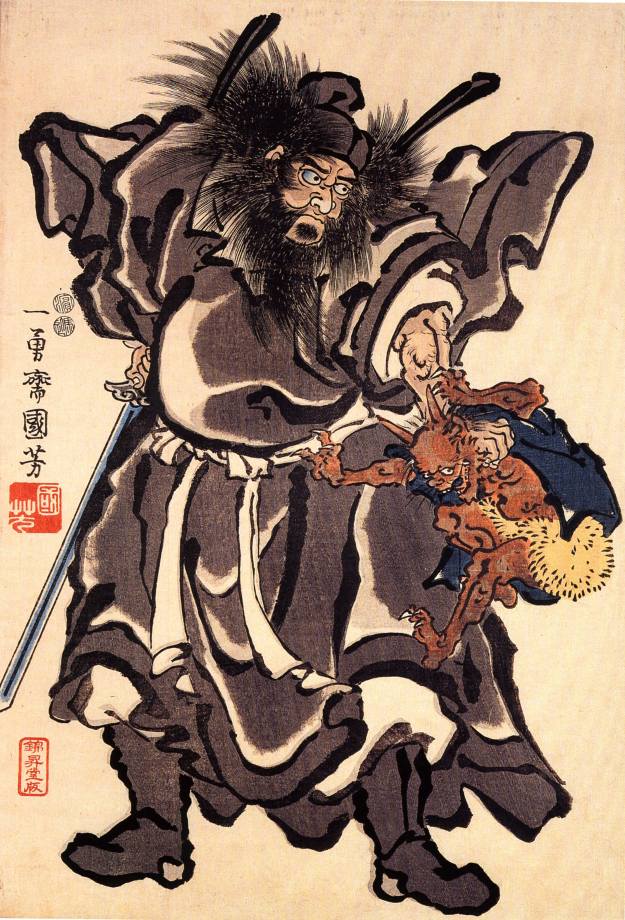
Following last year’s successful performance of the virtuoso Noh Mochizuki, on March 20th 2016 Udaka Tatsushige is going to stage his second independent Noh event. This year he is going to perform the rare play Shōki. Shōki (in Chinese Zhong Kui), a character known in China and in Japan, is characterised by a massive beard, hence the theme of this event, ‘beards’.

The event is going to feature a very special guest: poet Tanikawa Shuntarō, who will read poems from his repertoire, including Hige (‘Beards’). Other performances in the program are the solo chant with drum accompaniment from the noh Sanemori (Udaka Michishige and Kawamura Sōichirō) and the Kyogen Akutaro (Shigeyama Yoshinobu), all of which are stories about bearded characters.

For more information about the program and to reserve a seat please visit Tatsushige’s site (in English).

Shōki (also romanized as Syouki) is a legendary character who lived in China during the Tang dynasty (618-907). Having failed the legendarily difficult admission exam to become a civil servant, he committed suicide. When Emperor Genso was informed of these facts, he dressed Shōki’s dead body in green court garb, bestowing official rank, and provided for a generous burial service. Before long the spirit of Shōki, now in the underworld, regretted having killed himself, and swore to protect the country. He then became a household deity with a fierce aspect, driving away evil spirits and curing illness. In Japan Shōki can be still seen drawn on paper amulets against smallpox, as a doll given to children when they turn five, or as a guardian figure on the roofs of old houses.

Shoki_the_demond_queller

‘Shoki, the demon queller’ by Utagawa Kuniyoshi.

Udaka 2015 Independence Day, and INI Gala Recital 2016

In the early hours of September 13th 2015 Udaka Michishige continued with putting the finishing touches on the Deigan mask he would use later that day in his performance of Teika, the center piece of the 16th Seirannoh-no-kai at the Kongo Noh Theatre: adding more color, polishing, pausing to check the effect once again. This was the latest effort in the search for the essence of the expression of the Deigan mask, in this case for the essence that would most effectively portrayal his interpretation of the spirit of Princess Shokushi Naishinno. As always the process was continuing until the last possible moment.

His thoughts at this time as he kept on with this search included welcoming the 45th observance of his independence as a Noh actor and also his wishes for INI members. “Independence” can mean embarking on a lonely road and uncompromising battle of seeking the essence of your art. Michishige continues to be his own harshest critic and taskmaster, but he also treasures and finds strength in fellow travellers on the path. He hopes that you, too, as his fellow travellers are keeping to your path of seeking the highest essence in your endeavours.

Michishige also looks forward to sharing in training and performing Noh with as many of you as possible in the Gala Noh Recital at the Kongo Noh Theatre on August 21, 2016. More details will be coming soon, but please put the date down on your calendar and get in touch with us with any questions. As always at INI will do what we can to facilitate your participation.

In closing, the performance of Teika was very well received. Here are a few photos from the performance though they are hardly a substitute for the experience of the performance itself.

Rebecca Teele Ogamo

Kongo Monthly Noh 26 April 2015 – ‘Oshio’

On Sunday 26 April 2015 Udaka Michishige will perform the Noh Oshio, a piece not frequently put on stage by the Kongo School. The play is attributed to Konparu Zenchiku, and draws from the Tales of Ise and from the poetry collection Kokinshu. The main character is in fact the celebrated Heian period poet Ariwara no Narihira (825-880), a central character in other Noh plays, such as the third category (women Noh) plays Kakitsubata and Izutsu. However in Oshio Narihira appears as himself – first as an old man, and later in his original garb, as a Heian period courtier.

26 April 2015 (Sun) from 13:30. Noh: Oshio – Udaka Michishige. Kongo Noh Theatre. Kyoto.

Ariwara no Narihira in a painting by Kano Tanyu

Oshio synopsis by Rebecca Teele

A Man goes with his Companions to Mt. Oshio having heard that the cherry blossoms are in full bloom there. Among the many flower viewers is an Old Man carrying a branch of blossoms. The Men speak with him and are impressed by his elegant expression of appreciation for the blossoms. He quotes poems by Ariwara no Narihira (825-880) nobleman and courtier, in particular one relating to the visit to the area by the Empress of the Second Ward, Fujiwara no Koshi, who was secretly his lover for a time. The poem reads: Ohara ya, Oshio no yama mo, kyo koso wa, kamiyo no koto mo, Omoiizurame and is translated by Helen McCullough in Tales of Ise as: “On this auspicious day, the divinity of Mt. Oshio at Ohara, will surely remember, what happened long ago, in the Age of the Gods.” The Old Man is, in fact, the spirit of the ‘Man of Old’, the poet Ariwara no Narihira in a transformed state. Later he appears in his true form in a blossom decorated ox cart and dances, remembering incidents of the past and praising the beauty of the cherry blossoms.

For more information on the performance, or to reserve a ticket contact the INI.

Noh Photography #2 Stéphane Barbery

Here is the second of a series of posts on photographers who have worked with the INI and with Udaka Michishige. (See the first post of the series, featuring Irwin Wong). This time we have asked Stéphane Barbery to contribute to our blog with his thoughts on photographing Noh. Stéphane is a French writer and photographer living in Kyoto, where he studies traditional arts since 2008. He is currently working on a ten-year book project on Japanese beauty. Stéphane is a regular Noh theatregoer, and has taken pictures of a great number of Noh performances, as well as other performing arts. His personal take on Noh is apparent in the stunning pictures that capture the intensity of performance moments. We have met Stéphane on a number of occasions in Kyoto, and have always been impressed by his passion for Noh and determination to disseminate it internationally. Find out about Stéphane’s many activities on his blog and his Flickr page.


I consider Noh as an atheist religious experience. It is not “just an(other) exotic entertainment”. Noh is the most noble and intense form of collective trance that I know. It purifies the heart and restores faith in the kindhearted nature of human beings. The photographer must thus take all the necessary steps to preserve the masters and the sense of trance in the audience. This means :

1) Being invisible.

a) Avoid strobes or added lightings.

b) Staying usually in the back of the room which implies using a long zoom. I’ve discovered that the equivalent of a full frame 600mm is necessary in order to take pictures that are framed enough so that the non-acting people on stage (specially the musicians and the koken stage assistants) do not show on the background of a picture creating a visual noise that dilutes the emotion of a movement that usually relies on a detail in a fraction of a second. I also want to avoid “static” pictures that, from my point of view, lose all the specific dynamic energy of Noh. It means that I take a lot of pictures and carefully select the most intense ones during the processing phase.

2) Being absolutely silent. Technology (specially after Panasonic Gx7) allows to take pictures in total “silent mode” with no shutter or lens motor sounds.

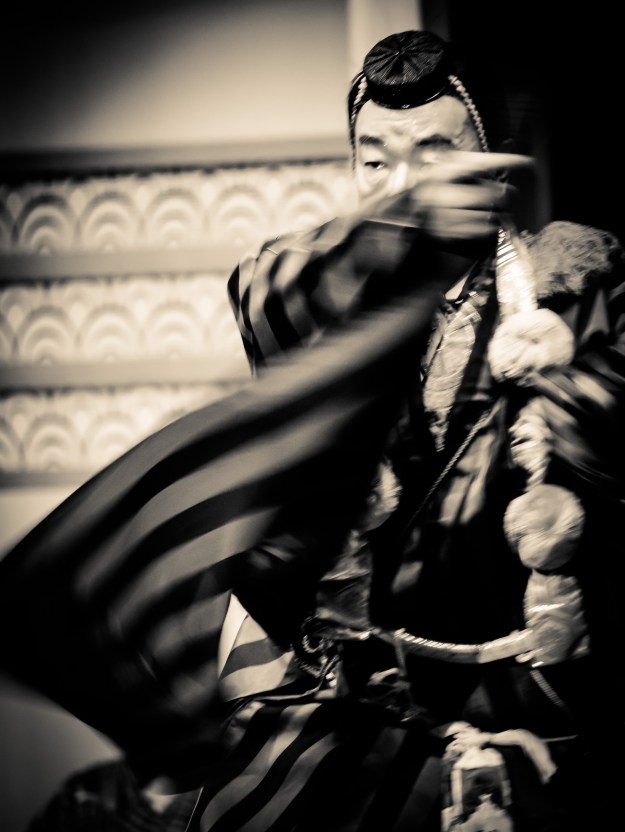
B) Photographers should never aim for verisimilitude but should try to share the peak of  the emotions they felt. During the development of pictures (nowadays, with digital photography, on a computer using Adobe Lightroom), they should feel totally free to modify every parameter of the shot (colour, contrast, lighting, frame, etc.) in order to convey the intensity of what they saw. If the colours of his file, considering the limits imposed by the effort to be ‘invisible’, can be mixed in a noise that does not honor the genius of the colours and patterns displayed on a Noh stage, then it is best to shift to monochrome in order to underline the detail they want to share.

C) The exceptional nature of Noh is not only seen during the short time of the stage but also in the lifetime preparation process of the Noh performers. My dream is to be able to take pictures of all the dimensions of this “behind the scenes” world so that those who cannot get the chance to access it can understand the number of skills required to be a Noh master, but also how intensively those professionals are dedicated to their art. As such they are true sources of inspiration who deserve to be much more honoured than they are nowadays.

Stéphane Barbery

Noh: Ataka. Shite: Udaka MIchishige. Photo: Stéphane Barbery

Noh: Ataka. Shite: Udaka MIchishige. Photo: Stéphane Barbery

Noh: Ataka. Shite: Udaka Michishige. Photo: Stéphane Barbery

Noh: Ataka. Shite: Udaka Michishige. Photo: Stéphane Barbery

Noh: Ataka. Shite: Udaka MIchishige. Photo: Stéphane Barbery

Noh: Ataka. Shite: Udaka MIchishige. Photo: Stéphane Barbery

Noh: Hagoromo. Shite: Udaka Tatsushige. Photo: Stéphane Barbery

Noh: Hagoromo. Shite: Udaka Tatsushige. Photo: Stéphane Barbery

Noh: Hagoromo. Shite: Udaka Tatsushige. Photo: Stéphane Barbery

Noh: Hagoromo. Shite: Udaka Tatsushige. Photo: Stéphane Barbery

Diego Pellecchia getting dressed for the rehearsal of the Noh 'Kiyotsune'. Photo: Stéphane Barbery

Diego Pellecchia getting dressed for the rehearsal of the Noh ‘Kiyotsune’. Photo: Stéphane Barbery

The Y-shaped kibane, a wooden piece that sustains the heavy okuchi-wide trousers. Photo: Stéphane Barbery

The Y-shaped kibane, a wooden piece that sustains the heavy okuchi-wide trousers. Photo: Stéphane Barbery

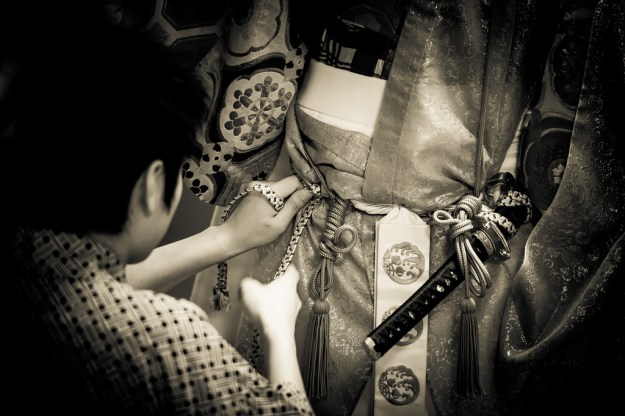
Adjusting the costume for the rehearsal of the Noh 'Kiyotsune'. Photo: Stéphane Barbery

Adjusting the costume for the rehearsal of the Noh ‘Kiyotsune’. Photo: Stéphane Barbery

Diego Pellecchia bowing to the Chujo mask before the rehearsal of the Noh 'Kiyotsune' Photo: Stéphane Barbery

Diego Pellecchia bowing to the Chujo mask before the rehearsal of the Noh ‘Kiyotsune’ Photo: Stéphane Barbery

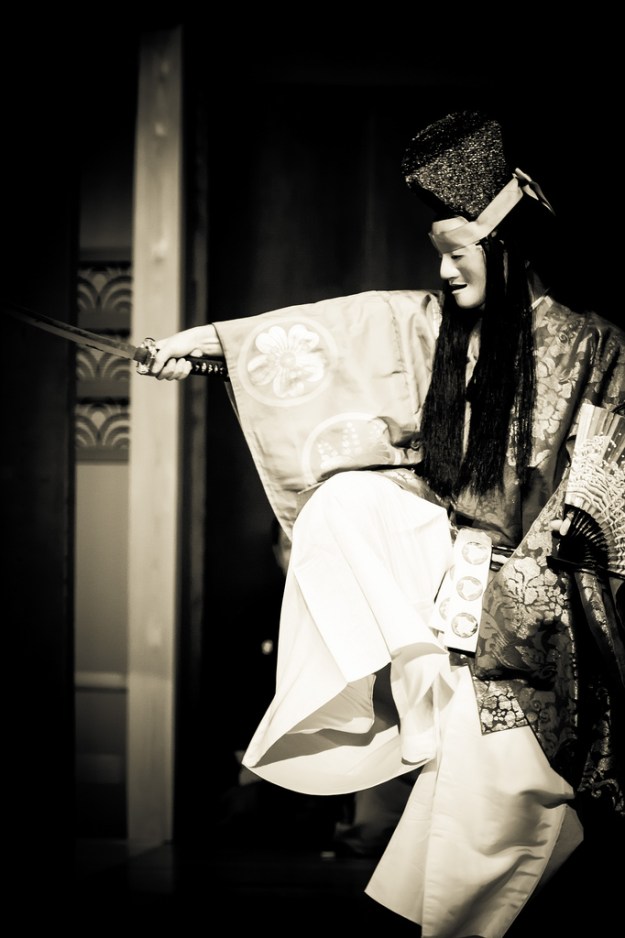
Noh: 'Kiyotsune'. Shite: Diego Pellecchia. Photo: Stéphane Barbery

Noh: ‘Kiyotsune’. Shite: Diego Pellecchia. Photo: Stéphane Barbery

Noh workshop + Hagoromo in Naples

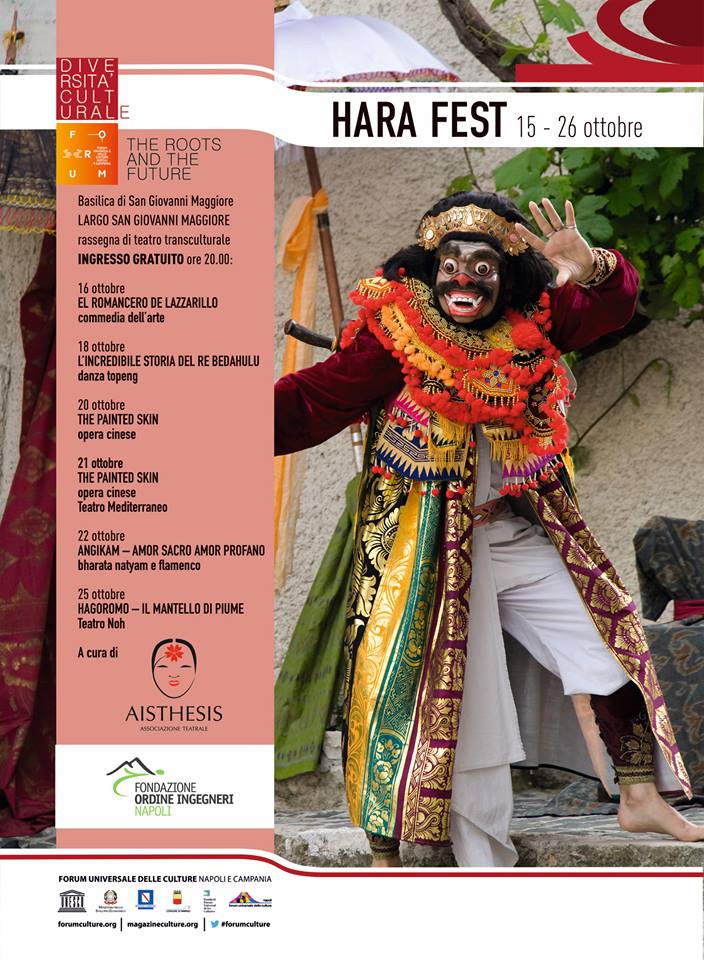
On 25 October 2014 at the Basilica di San Giovanni Maggiore in Naples the Italian branch of the International Noh Institute will perform a reduction from the Noh Hagoromo (‘The Robe of Feathers’) at Hara Fest, an Asian theatre festival organised by Aisthesis and the Forum Universale delle Culture. Naples has a long-standing tradition of cultural-exchanges with Asia. The famous Orientale University hosts one of Italy’s major centres for Japanese studies.

On the same day, from 10:00 to 13:00 and from 14:00 to 18:00 Kongo School licensed instructor Monique Arnaud will also hold a Noh workshop at Teatri 35, Largo Proprio di Arianiello 12, 80138 Naples, Italy.

1908435_10201810131935419_4426352329186318000_n-2

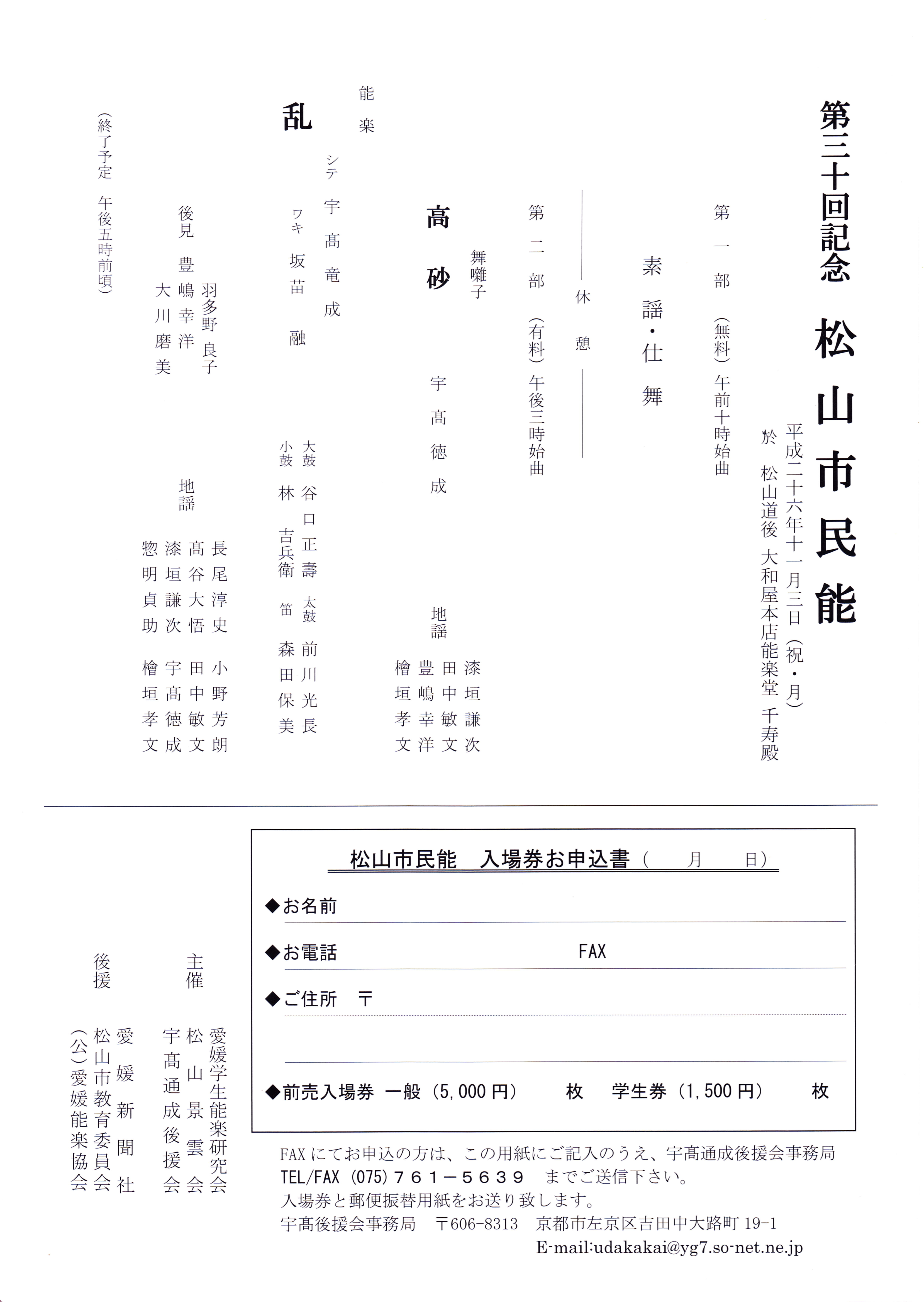
30th Matsuyama Shimin Noh 2014 – Midare

This year the Matsuyama Shimin Noh celebrates its 30th anniversary! On November 3rd 2014 Udaka Tatsushige, Michishige’s elder son, will perform the Noh Midare, a special variation (kogaki) of the Noh Shōjō. Udaka Norishige, his younger brother, will perform the maibayashi (chant and dance excerpt with instrumental dance) from the Noh Takasago.

From 10:00 to 14:30 students of Udaka Michishige will perform dance and chant excerpts. INI members will also participate with the following shimai: Rebecca Teele Ogamo (小鴨梨辺華): Ochiba, Diego Pellecchia (高谷大悟): Kantan, Elaine Czech: Ukon. The performance of Takasago and Midare will begin at 15:00.

matsuyama_14_final

30th Matsuyama Shimin-Noh performance

3 November 2014 Matsuyama (Ehime prefecture) Dogo Yamatoya Nohgakudo 10:00 – 17:00

Part I (10:00 – 14:30)
Student recital of chant and dance – free of charge

Part II (15:00 – 17:00)
Maibayashi: Takasago. Shite: Udaka Norishige
Noh:  Midare. Shite: Udaka Tatsushige

Tickets: General Admission ¥5,500   Advance Sale: ¥5,000
Student Admission ¥1,500

For questions and reservations contact us.

KYOTO INI Main Offices, Training Center 111 Satta-cho, Kami-takano, Sakyo-ku, Kyoto 606-0047 Fax: +81 (075) 701-1058 Email: ini.kyoto (at) gmail.com


Midare (synopsis by Rebecca Teele Ogamo)

A young man named Kofu living at the foot of Mt. Kanekin in China is a virtuous and dutiful son and as a reward for these traits he is granted a dream oracle in which he is advised to open a wine shop near the Yangtze River. He does so and becomes very prosperous. One day a stranger comes to the shop. No matter how much he drinks his complexion never changes and he never seems to become drunk. When Kofu asks his name he says he is Shojo and that he lives in the sea. Shojo invites Kofu to meet him at the Bay of Jinyo on the western part of the Yangtze River.

The Noh begins with Kofu’s narration of these events. He explains that he is on his way to meet Shojo at that moment. He admires the moon as he waits at the appointed place and anticipates the pleasure of drinking wine with his friend. Shojo enters and the chorus describes wine as a medicine or elixir with the power to keep those who drink it from aging. Shojo offers to dance in celebration of their friendship. With the sound of the booming of the waves as a drum and the wind through the waves as a flute to accompany him, he dances: now on the beach, now in the surf along the Bay. His dance ends, but before he leaves he praises Kofu for his obedient heart and as a gift he presents him with a jar of wine which will never run dry. He dips the wine and drinks, then with faltering steps sinks down to rest. When Kofu himself awakens from his drunken slumber he finds that the Shojo has disappeared, but the jar of wine remains, a spring of wine that will be inexhaustible for generations to come.

Midare features the midare-ashi, a particularly unusual and challenging dance sequence, is performed instead of the usual chu-no-mai medium tempo dance.

Though the original play Shōjō was a typical two part Noh, over the years it was abbreviated to its present one-scene form. The play TaiheiShōjō in the Kanze school repertory is considered to be another early rendition of the story and is a Noh in two parts.

Matsuyama_Midare_2