On the performance of Sagi at the Seiran Noh 2016

We publish here some thoughts on Udaka Michishige’s performance of Sagi (The Heron), by Rebecca Teele Ogamo.

The Seiran Noh performance of Sagi on September 11th, 2016 celebrating Udaka Michishige’s 70th birthday was one of the plays featured in the Kansai area Noh reviews in the Nohgaku Times. As the critic points out, the story is a demonstration of how a bird, without spirit or mind, shows its gratitude towards the emperor and has no real emotional expression. This being the case, the success or failure of a performance rests on the actor’s skills, refined over time, to portray the sense of purity and innocence of the heron through making the face a vehicle of abstract expression, as a mask is not used, but is performed hitamen, or with the face as a mask, or instead of a mask. The critic was especially impressed by the way that Michishige was able to do this, keeping his face completely devoid of expression. His portrayal of the utter stillness of the bird when it stopped, as though perching without moving had a majestic grace, and the seemingly effortless performance of the unique and extremely difficult dance of the heron, meticulously and without any wasted movement, seemed to reveal to the audience the actual heron on the shore of the pond.


michsihige-sagi

Udaka Michishige as ‘the heron’ in Sagi. Udaka Seiran Noh. Kongō Nōgakudō, 11 September 2016. (Photo: Oka Tetsuya)


I have seen Udaka-sensei in other hitamen roles, but always as in the role of a living person, as in Hachinoki or Mochizuki, or of a ghost manifesting as a living person as in the first half of Atsumori. This was the first time to see him in the role of a non-human creature, relying on completely on focused movement, rather than a mask, to portray the essence of the heron. I was startled when I realized that I was no longer aware of an actor or his face, but felt I was watching a heron as it danced. The critic seemed to confirm this experience. “I wonder what kind of Sagi I will be?” Michishige mused one day after a mask carving class. I think it was the natural result of years of dedicated uncompromising practice.

Whatever our path, challenges are limitless, and the base and foundation on which we pursue them must always be a constant refining of basic skills.

For INI, too, this means a continuing renewal of our commitment to sharing and exploring the traditions of Noh. We grow and gain energy through shared experiences of how we test our limits. Please let us know about your path and progress, and know we support you in your challenges.”

Rebecca Teele Ogamo

michishige-sagi-nogaku-times

Photos from the 2016 Kei’un-kai INI Taikai Gala Recital

Fabio Massimo Fioravanti, who has already collaborated with Udaka Michishige on various projects, including the book La Via del Noh – The way of Noh captured these beautiful moment from our last Taikai Gala Recital at the Kongo Noh Theatre on August 21st.

We would like to congratulate all participants – in particular Monica Alcantar, Lisa Swinbanks and Regina Toon, our INI Summer Program graduates! Well done! See you again soon!

Kei’un-kai INI Gala Recital 2016

Kei’un-kai INI Gala Recital 2016 Celebrating Udaka Michishige’s 70th birthday

Place: Kongō Noh Theatre

Date: 21 August 2016 Time: from 09:00 until 17:00

Entrance Free of Charge

This year’s Kei’un-kai INI Gala Recital (21 August 2016 from 09:00) celebrates the 70th birthday of our teacher and leader, Kongō School Master-Actor Udaka Michishige. In the Sino-Japanese tradition, the 70th birthday is considered a special event, to be celebrated in style. Its name (古稀 koki), derives from a poem by Chinese literate Tufu (Toho, 杜甫, in Japanese): jinsei nanaju korai mare nari (人生七十古来稀なり), meaning that in those days it was rare to reach the age of seventy.

The event features various performances, including two full playsHagoromo and Sesshōsekinyotai variant; two maibayashi dance and chant excerpts with musical accompaniment,  Tomoe and Yamanba; as well as numerous chant and solo dance pieces. See the program below.

This year the INI will be represented by Senior Director Rebecca Teele Ogamo, singing in a rengin excerpt from the noh Hanjo, and Junior Director Diego Pellecchia, performing the shimai solo dance excerpt from the play Kurama Tengu. Pellecchia will also sing in various choruses for other performances. INI Summer Intensive Program 2016 participants Monica Alcantar, Regina Toon, and Lisa Swinbanks will also perform shimai dances.

Kei’un-kai INI Gala Recital 21st August 2016
Kongo Noh Theatre, Kyoto
PROGRAM

09:00
Kami-uta (recitation of the ritual performance Okina)
Su-utai (solo chant of a full play): Shunkan
10:00
Rengin (chant excerpt): Hashi-Benkei
10:25
Shimai (dance excerpt with chant): Oimatsu; Yuya; Shōjō (performed by the INI 2016 Summer Program Participants)
10:40
Shimai: Atsumori (kuse); Kokaji (kiri); Tsurukame; Tsunemasa; Chikubushima; Yuki; Ashikari; Koma no Dan; Makura-jidō.
11:25
Maibayashi (dance excerpt with chant and music): Tomoe (Itō Yūki)
Bangai shimai (performed by professional actors): Tama no dan (Udaka Norishige); Tanikō (Udaka Tatsushige)
12:00
Noh: Hagoromo (Hirasawa Yumiko)
13:20
Maibayashi: Yamamba (Chiba Mariko)
13:50
Rengin: Hanjō

Bangai shimai: Kumasaka (Udaka Michishige)
14:20
Noh: Sesshōseki – Nyotai (Kurochiku Tokindo)
15:50
Shimai: Kurama Tengu; Izutsu; Yorobōshi; Uta-ura (kuse); Himuro; Hanagatami; Kayoi Komachi; Uta-ura (kiri); Aoinoue; Shokun.

Ending time: 17:00

INI trainees – Hana Lethen

hana_4

Hana Lethen

Hana Lethen lives in Texas and is a junior at Princeton University majoring in Comparative Literature, with a focus on Japanese and Russian language and culture. She spent her spring semester 2016 in Kyoto studying Japanese language, society, and traditional theater through Columbia University’s Kyoto Consortium for Japanese Studies.

Hana decided to take her exploration of Noh to a higher level, attending a number of performances along with fellow KCJS students, and also practicing Noh chant and dance with the INI. Here are a few insightful reflections on her experience.

Diego Pellecchia, INI Junior Director


Discovering Noh Through Dance

by Hana Lethen

When I asked Monica Bethe, the professor for a course on Noh that I took this past semester, for support regarding my final paper comparing ballet and dance in Noh theater, I was expecting book recommendations. So, I was a bit incredulous when she suggested that I take lessons— “the best way to learn is to dobut soon realized what a great opportunity had presented itself.

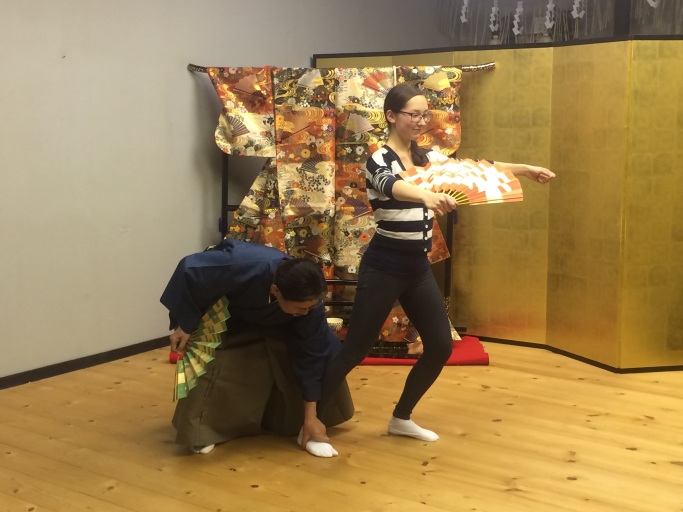
With an introduction and much help from Diego Pellecchia, who was co-teaching my Noh course, I went to okeiko every week during my last month in Kyoto. On the first day, I was very nervous. The only thing I knew to expect was that okeiko would be very different from practicing ballet, which I have done since I was five years old. I had an impression of Noh as a very traditional and elite art, so I expected okeiko to be somewhat rigid.

However, when I entered the okeikoba, I was surprised by the intimate and almost relaxed atmosphere. First, we spent about an hour having tea and chatting with Udaka-sensei, who, for all his talents and experience, was very kind and not at all intimidating. It was during this tea session that I began to realize that the constrained schedule of normal life does not apply to the okeikoba. Time here is fluid; okeiko starts and ends basically when Udaka-sensei deems appropriate. Noh is a combination of religious ritual and artneither of these can be rushed.

IMG_4970

Learning the hiraki kata

We began my first lesson with a bit of practice chanting the text which accompanied the dance from Tsurukame which I was to learn. I have always dreaded singing or speaking onstage, so my thoughts at this point were along the lines of “I came here to learn the dance, not the chanting…” But, I realized that a large part of the beauty of Noh comes from the unity of dance and poetic text, so I overcame my initial reservations.

Learning the dance, too, proved to be as much about “letting go” as it was about precisely learning the movements. Having extensive ballet experience was helpful in terms of coordination, but it also meant that I had some assumptions about dance lessons that were challenged in okeiko. At first, I somewhat expected Udaka-sensei to break down each movement for me, as a ballet teacher would do. More than this, however, my okeiko involved watching Udaka-sensei’s movements and imitating them as carefully as possible. Like much Japanese traditional fine art, dance in Noh is subtle, but expressive; restrained, but powerful. Although some movements felt unfamiliar, I tried to understand the general flow of the dance.

I was impressed by the atmosphere at the okeikoba of humility and of respect for the art of Noh. I was also touched by the attention Udaka-sensei devoted to each of his pupils—even to me, a complete novice. Reading and learning about Noh, and also seeing Noh performances, as part of my academic course was extremely valuable, but getting a small glimpse from the performer’s perspective in okeiko made Noh come alive for me in an entirely new, exciting way. Professor Bethe was right—I am not sure how I would have written my final paper for her and Diego’s course without firsthand experience of dance in Noh. And, ultimately, I gained much more from okeiko than a final paper. I developed very special appreciation for Noh through an experience that I would love to have again if I get the chance.

Thank you, INI!

IMG_0888

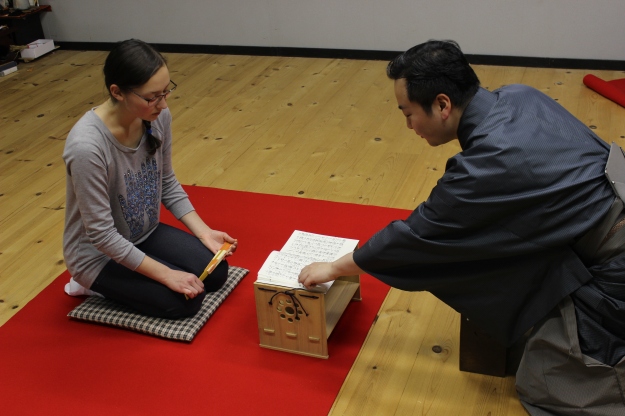
Chant lesson with Udaka Norishige

Only one position left – INI Summer Intensive Program 2016

If you are considering applying to the INI Summer Intensive Program, hurry up! There is only one position left before we close applications.

The INI – International Noh Institute is now accepting applications for its 2016 Summer Intensive Program. Participants will join INI members for a 2-week intensive training period. Read more: INI Summer Intensive Program 2016

INI Summer Intensive Program 2016

The INI – International Noh Institute is now accepting applications for its 2016 Summer Intensive Program. Participants will join INI members for a 2-week intensive training period, during which they will study Noh chant and dance at the INI headquarters in Kyoto with master-actor of the Kongō school, Udaka Michishige. During their stay, participants will be able to learn various aspects of noh, including masks and costumes.

Lessons follow the traditional methods of the Kongō school, providing participants with the unique chance of frequenting the okeikoba, private training space of a noh master, for an immersive experience.

Participants are also welcome to join the August 21st Kei’unkai-INI Gala Recital, along with Udaka Michishige’s international and Japanese students, on the prestigious stage of the Kongō Noh Theatre, in Kyoto.

INI SUMMER INTENSIVE PROGRAM 2016

Requirements: Anyone is welcome to join – no previous knowledge of Noh is required. Lessons are delivered in English and/or Japanese.

Capacity: 5 participants

Place: INI Headquarters, Kyoto

Period: August 1 – 14 2016

Fees (in Japanese yen)

Regular 60,000
Student 40,000
Recital at the Kongo Noh theatre (optional) 20,000
  • Participants are required to purchase separately the necessary personal items for noh practice: tabi white split-toe socks (around 700yen) and a Kongō-style Noh dance fan (5000yen).
  • Participants are required to arrange for their accommodation.

How to apply: send us an email at ini.kyoto[at]gmail.com Please attach your C.V. and a brief statement of interest.

Read impressions of the INI summer training from participants Sadia Gordon and Dorothee Neff.

Images from past events


Shinonome Noh 2016: Tamura

INI founder Udaka Michishige is a descendant of the Udaka Clan, serving the Matusdaira feudal lords in Matsuyama, Shikoku as Noh actors from 1712 until the beginning of the Meiji period.

In Matsuyama, Michishige has an okeikoba training space, where INI members also train intensively. Regular performance events in Matsuyama include Shinonome Noh and the Matsuyama Shimin Noh. The Shinonome Noh is an annual Noh and Kyogen event taking place at Shinonome Jinja, a shinto shrine located on the hill dominated by Matsuyama Castle. Michishige has collaborated with Shinonome shrine cataloguing and restoring the vast Noh masks and costumes collection.

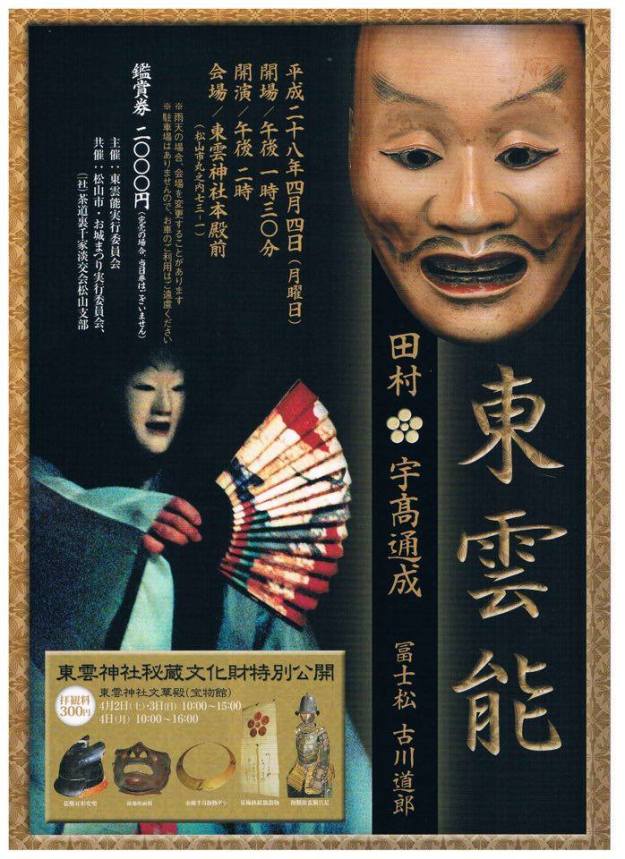
This year’s Shinonome Noh performance will take place on April 4th (Monday) from 14:00 (gates open at 13:30), and will feature the Kyogen Fujimatsu and the Noh Tamura. INI member Diego Pellecchia will sing in the chorus (in the program he is listed under his Japanese name, 高谷大悟 Takaya Daigo). Tickets: 2000yen.

12895357_578673225643811_295263240_n

Tamura tells the founding myth of Kiyomizu Temple in Kyoto in the early 9th century. Having defeated a rebellion in the East lands thanks to the divine intervention of the Bodhisattva Kannon, General Sakanoue Tamuramaro became a benefactor of the temple. The first half of the play, set at Kiyomizu temple in spring, is characterised by the images of cherry flowers in full bloom. By contrast, the second half describes the battle between Tamura’s army and the rebels, ending with words of praise for Kannon.

12900110_578673245643809_32590024_n

The Second Tatsushige no Kai: Shoki – 20 March 2016

Following last year’s successful performance of the virtuoso Noh Mochizuki, on March 20th 2016 Udaka Tatsushige is going to stage his second independent Noh event. This year he is going to perform the rare play Shōki. Shōki (in Chinese Zhong Kui), a character known in China and in Japan, is characterised by a massive beard, hence the theme of this event, ‘beards’.

The event is going to feature a very special guest: poet Tanikawa Shuntarō, who will read poems from his repertoire, including Hige (‘Beards’). Other performances in the program are the solo chant with drum accompaniment from the noh Sanemori (Udaka Michishige and Kawamura Sōichirō) and the Kyogen Akutaro (Shigeyama Yoshinobu), all of which are stories about bearded characters.

For more information about the program and to reserve a seat please visit Tatsushige’s site (in English).

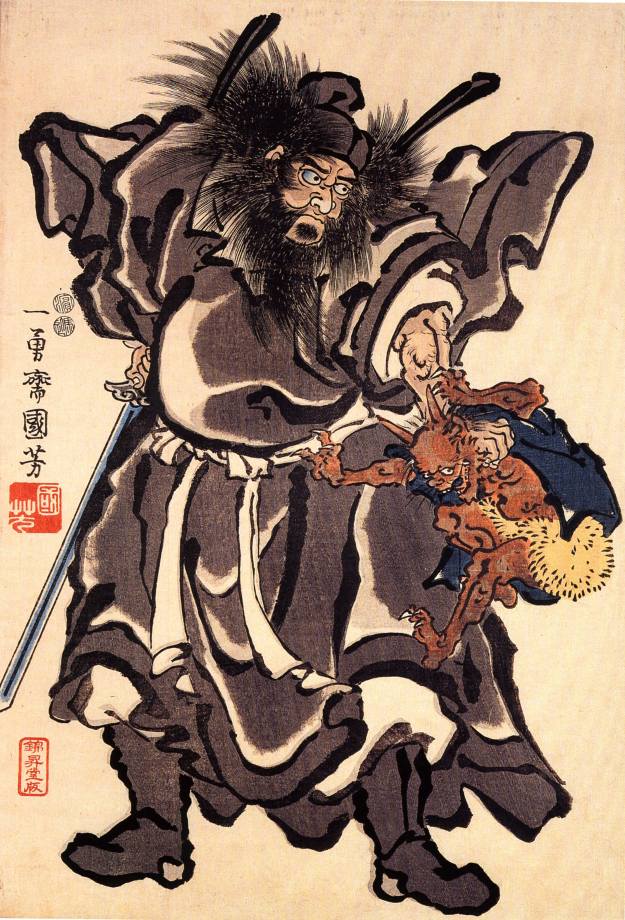
Shōki (also romanized as Syouki) is a legendary character who lived in China during the Tang dynasty (618-907). Having failed the legendarily difficult admission exam to become a civil servant, he committed suicide. When Emperor Genso was informed of these facts, he dressed Shōki’s dead body in green court garb, bestowing official rank, and provided for a generous burial service. Before long the spirit of Shōki, now in the underworld, regretted having killed himself, and swore to protect the country. He then became a household deity with a fierce aspect, driving away evil spirits and curing illness. In Japan Shōki can be still seen drawn on paper amulets against smallpox, as a doll given to children when they turn five, or as a guardian figure on the roofs of old houses.

Shoki_the_demond_queller

‘Shoki, the demon queller’ by Utagawa Kuniyoshi.

Noh changes with imagination | Tatsushige Udaka | TEDxKyotoUniversity TEDx Talks

Udaka Tatsushige’s TEDxKyotoUniversity talk on Noh is finally available with English subtitles! Enjoy and let us know what you think!

Noh, a classical Japanese musical drama, is not just what you see with your eyes, but what see with your mind too! This talk/performance will show you that in interpreting Noh, imagination is your limit!

Tatsushige Udaka was born in Kyoto, and started his career in Kokata acting from the young age of three years old. He was trained by the 26th head of the Kongo School, Hinasori KONGO, as well as by his father, Michishige UDAKA. Performing since he was young, he has had extensive stage and teaching experience in Noh Threatre. He has travelled, performed, taught, and demonstrated Noh in Japan, South Korea, France, and the United States throughout the last decade. Currently, he is based in Kyoto.