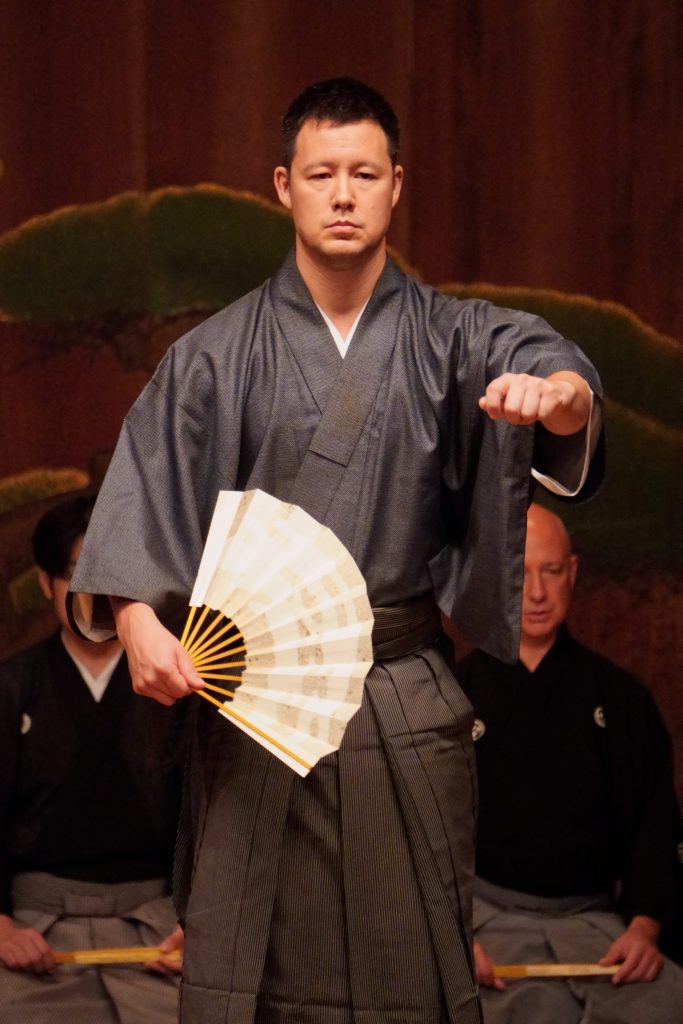
My first encounter with nō was probably through Akira Kurosawa’s movie Kagemusha, which I must have seen for the first time in my late teens or early twenties. Toward the end of the movie, Ryū Daisuke, who plays Oda Nobunaga, dances a part of the nō play Atsumori. This made an enormous impression on me. Later, when I was visiting Tokyo in 2008 during an art residency, I was able to see nō for the first time in person. Eventually I started formal training in Fuke Myōan shakuhachi, and later found a teacher willing to introduce me to the fue, the transverse flute played in the nō musical ensemble, the hayashi. Thus the desire slowly grew to understand more about the broader context of nō dancing and chanting, which the fue supports. And so I arrived at the International Noh Institute in Kyoto in its 40th anniversary year.
The experience was an overwhelming one. Initially, the proposed schedule seemed reasonable: 3 hours of teaching per day, with ample time for self-study and other activities. But the reality quickly dawned on me and the other participants of the 2026 cohort that learning three shimai within the period of two weeks with the aim of performing one of them live on a real nō stage at the end was a tall order. Our teachers Udaka Tatsushige, Udaka Norishige, and Diego Pellecchia, however, were incredibly generous with sharing their time, experience, and wisdom. And nō, so I learned in this period, is incredibly accommodating to beginners and amateurs, despite what appears to be a somewhat forbidding formal facade. All in all this made my experience at INI incredibly nourishing and rewarding and something that I will carry forward in my own engagement with Japanese traditional performing arts.
Vincent Yūsui van Gerven Oei
Photograph: Udaka Sanami