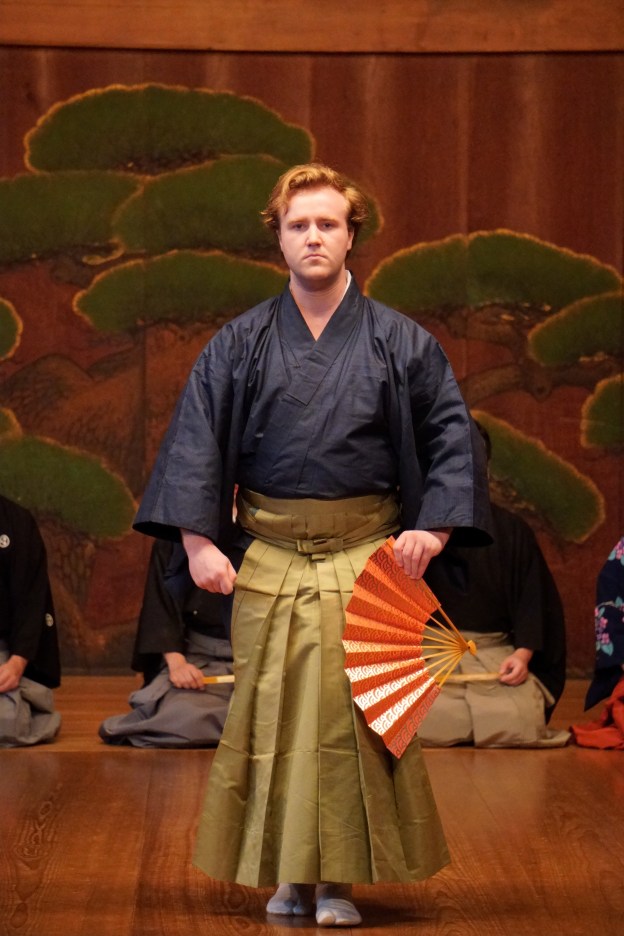
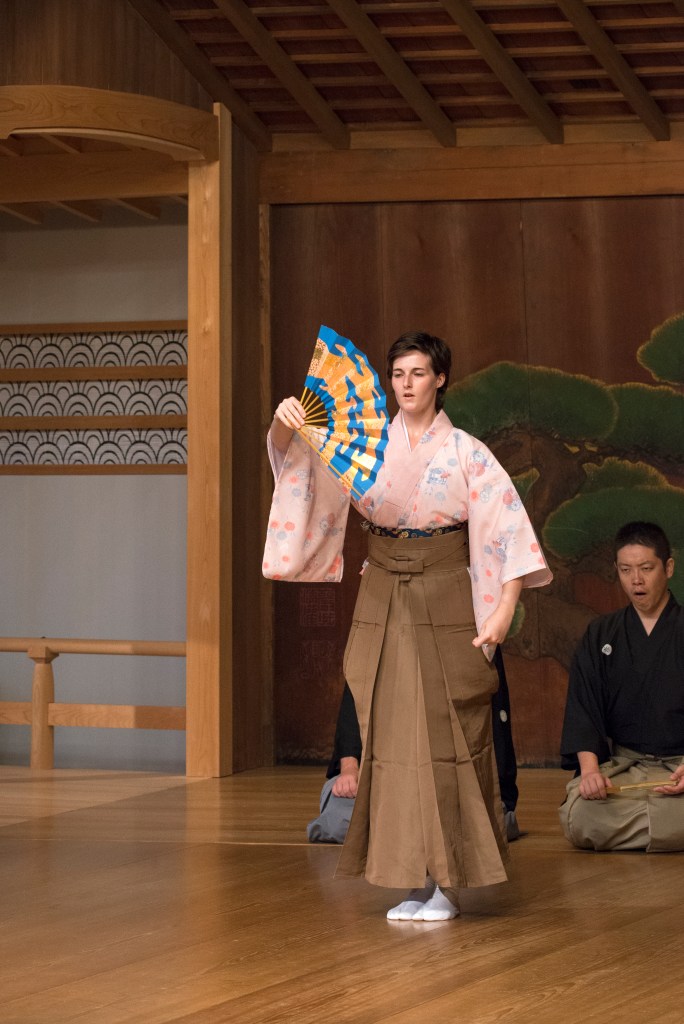
During my two-week training with INI, I had the opportunity to experience and embody nō forms and expressions while learning about the philosophy behind them. We formed a warm and supportive group, practicing together with the teachers every day. The final recital was incredible, and performing on stage alongside professional actors was an unforgettable experience.
I attended the INI program in order to provide supplemental research/training for the completion of my thesis project. Though I had been researching Noh for quite some time prior to this, I did not see it playing a major role in my life moving forward. Even as I entered Japan this time round, I viewed the upcoming training as a nice excursion from my other interests. However, through INI, I was able to enter into a world completely unlike the one I was prepared for.
I found myself rubbing shoulders with practitioners of all different backgrounds, including academics, theater artists, professionals and more. These were entirely different people who shared a passionate devotion to the practice of Noh. I was deeply moved by the depth of this commitment which was woven into the fabric of each person’s very being. And I realized that this deep connection to Noh, and to a greater extent Japanese culture, was one that I, too, shared.
My entire life I have loved Japan. I have dreamt of coming here to experience the essence of Japanese culture. This is a devotion that I had never been able to adequately share before. INI provided to me a place of belonging I have been missing for as long as I can remember.
Each day, in lessons, in performance, and in the personal interactions fostered by the INI staff, I felt truly connected to a living community who cares for each other, who supports each other, and who pushes each other forward. It is an experience I will cherish all my life. I cannot recommend this program strongly enough to my fellow Japanophiles who search for community, because you will find it here at INI.
I am forever grateful to the Udaka family and Diego Pellecchia for the community they have fostered, and for the experience they provided to all of us students.
To start to know noh, you must know humility. As children, learning to walk is a milestone, and for noh, it is the same. When you are asked to forget what you understand about standing and begin to move as demons, divine beings, and wandering humans, you strip away the attachment to being right, and instead devote yourself to curiosity.
My greatest takeaway from INI’s Noh Intensive is that the simplest gesture or the thinnest wrinkle carved upon a mask can have the grandest meaning. Whether you are the suffering Yuya scanning the horizon for the solace of sakura, or Shojo bestowing the gift of everlasting sake to the generous shopkeeper, all these can be encapsulated in the gaze of the face or stream of the arm. Although there may have been fumbled footwork or warbled words, our eager inquiry into the imagery of the art form stripped us of our pride so we could breathe inside each character.
As the final demonstration ended, my reaction when ducking through the stage door was, “I wish I could perform again.” To me, that is the true sign of inspiration: longing to learn and share more. From the tips of my tabi socks to the final fold of the fan, I hope to humbly offer my knowledge of this art form to others through my work as an educator and writer. May this be the first step, the first kata, in a lifelong dance of coming to know Noh, and cheerily chanting that song to anyone willing to sing along.
The INI Summer Intensive 2024 was an invaluable experience, offering a rare opportunity to engage deeply with the world of Noh. The program culminated in a full day of performances, where we presented the dances we had trained for during the two weeks.
A key highlight of the program was the diverse team of instructors. Lessons were led by Noh Masters Udaka Tatsushige and Udaka Norishige, Professor Diego Pellecchia, and Mask Carver Udaka Keiko. Each brought a unique perspective to teaching Noh, enhancing our understanding of the complexity behind its stylized tradition.
I felt that this year was particularly special, as Diego Pellecchia featured his performance of Funa Benkei, an unforgettable Noh play. This gave us a rare glimpse into backstage practices and allowed us to witness a very rare rehearsal process firsthand, unusual for the world of Noh professionals. We also attended two additional plays, which we discussed together, enriching our appreciation with Diego’s expert insights.
Beyond the structured lessons, the program fostered casual conversations, creating a relaxed atmosphere where participants could ask questions freely. These spontaneous exchanges often led to profound discussions, enriching our learning experience even further.
Finally, I must mention the unique training environment of the INI program, the Udaka family’s training space. For me, it is an incredibly special place. INI offers the chance to train in the same space where Noh is taught and practised daily. Every time I entered, I felt a sense of humility and excitement, surrounded by the tools, books, and materials that speak to the living tradition of Noh and its daily life practices.
I am deeply grateful to the Udaka family and Diego Pellecchia for their intellectual generosity. I highly recommend the INI Summer Intensive Program to anyone interested in exploring the world of Japanese Noh theatre.
The INI – International Noh Institute announces its 2024 Summer Intensive Program. Applications open April 1 and close April 30.
Who can apply?
Anyone interested in studying nō chant and/or dance. There is no age limit, and previous knowledge is not required. The course is taught by English-speaking Japanese instructors.
What will participants learn?
Participants will study nō dance and chant according to the Kongō school tradition, and learn about various aspects of nō performance, including masks and costumes. The training period will culminate in a public recital, where participants will perform supported by professional actors at the Kongō Nō Theatre (details of the performance will be published later).
How does training work?
Nō classes take place daily, in the morning, or in the early afternoon. Participans will be coached by one of our instructors, but will also be encouraged to practice independently in preparation for the following class. A day-to-day calendar will be announced after the selection is complete.
What makes studying with the INI unique?
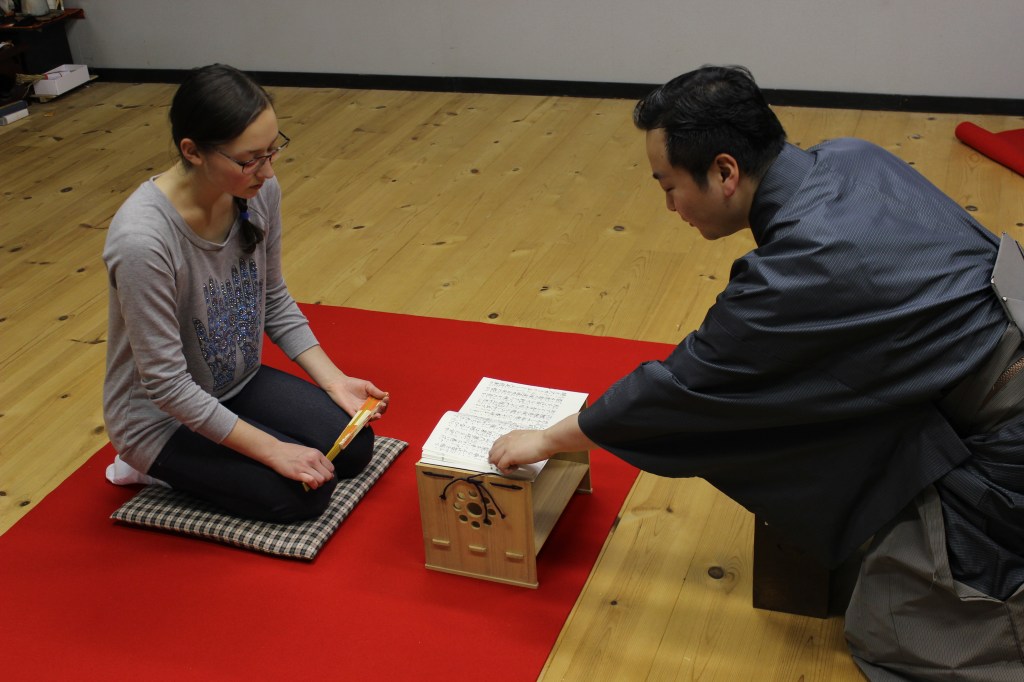
The intimate environment in which lessons take place, reflecting the traditional nō training style allows students to interact directly with the teachers. Lessons comprise both group work and one-to-one coaching.
The 2024 edition of our Summer Intensive offers an exclusive opportunity to observe the rehearsals of a full nō performance, which will be staged as part of the final Recital.
Program highlights
Train intensively in noh dance and chant.
Practice in a small group for an immersive experience.
Fees include: Dance/chant lessons, materials, Kongō school nō fan, participation in the final recital, and a certificate of completion. Fees do not include: White tabi (split-toe socks), transportation, accommodation, and any other personal expenses.
Payments should be paid before the start of the course via bank transfer. Further information regarding payment will accompany the notification of acceptance.
How to apply
Send an email to ini.kyoto[at]gmail.com attaching the following two documents:
Your Curriculum Vitae
A statement of interest (around 300 words)
Application calendar
Applications open: April 1 2024
Applications close: April 30 2024
Outcome announcement: May 15 2024
For more information about the program contact us.
Prior to the INI summer intensive program, my understanding of dance and drama was limited to the Western context. Further, my appreciation for the potential of the two was restricted by my cultural upbringing. During the two weeks of the program, through the instructions of the teachers, I learned to appreciate the depth of what Noh could be. Daily teachings and interactions with the teachers and hearing about the many plays and stories we could perform changed my view of how one could engage with a cultural activity and live life through its vehicle. Learning the chanting, the dancing, as well as the forms and symbols was challenging but deeply rewarding. To ultimately perform a Noh piece, as the culmination of days of hourly practice, was one of my proudest moments. I would recommend the summer intensive program to anybody who is interested in appreciating and understanding the potential of a tradition with a rich history that continues to thrives in modern times through its impact on those experiencing it.
I came to know nō theater through practicing traditional Japanese dance and watching the performance of the play Shakkyō in Hong Kong, where I was captivated by the mystery and mastery of nō. After facing various difficulties and setbacks in 2023, it was a great honor for me to participate in a two-week intensive training program in Noh theater in Kyoto. Amidst the hot summer days and the vibrant atmosphere of the Gion Festival, the two weeks of training allowed us to immerse ourselves in the artistic ambiance of Kyoto.
The three masters, Diego-sensei, Tatsushige-sensei, and Norishige-sensei, each possessed unique characteristics and taught the six of us, students from different parts of the world, in a meticulous and easy-to-understand manner. Diego-sensei offered detailed guidance on movements and storytelling; Tatsushige-sensei imparted wisdom from philosophical, Zen, and Shintō perspectives; and Norishige-sensei demonstrated movements akin to flowing water and gentle breeze, providing us with a full-body experience.
Although each student came from a vastly different background, everyone invested their wholehearted effort to excel. We were also fortunate to attend Keiko-sensei’s nō mask-making workshop, learn about the Gion Festival’s Yoiyama evening, receive assistance and translation from Monique-sensei, and have the experience of watching a Noh performance. In every aspect, the program provided a rich tapestry of nō-related experiences within the brief span of two weeks.
I am grateful for the encouragement and inspiration I received from the masters, which enabled me to participate with great honor in the final Noh theater performance, showcasing the fruits of two weeks of intensive training to family and friends. As the training period flew by, I found myself wishing that time could stand still to preserve these wonderful memories. I extend my gratitude to everyone who contributed to making this experience possible and to all my friends for their unwavering support.
Having the opportunity to learn and immerse myself in Noh theater in Japan under the guidance of Diego Sensei, Tatsushige Sensei, Norishige Sensei, Keiko Sensei, and Monique Sensei has been a life-changing experience that I will cherish for the rest of my life. I am grateful for the wise words, love, and passion that you have all shared with me, and for the trust that you have placed in me. You have helped me to fall even more in love with Noh and with my profession.
This summer, I had the privilege of joining five other participants from around the world in the esteemed Summer Intensive Programme of the International Noh Institute.
Central to the programme was the invaluable access to renowned Noh teachers, namely Udaka Tatsushige, Udaka Norishige and Diego Pellecchia, as well as the support and kind guidance of Monique Arnaud. Their expertise and dedication to preserving Noh as an art form were evident throughout their teachings.
Beyond the technical aspects of Noh – namely lessons on chanting and studying the movements known as kata which make up the dance part – the programme encouraged profound discussions on the artistic and philosophical underpinnings of the Noh plays and the essence of Noh itself. These in-depth conversations highlighted the spiritual dimensions of the performances.
One thought which crossed my mind was about how the essence of noh bears many similarities to the traditional concept of ‘the way’ or ‘dō’(道) ‒ evident in practices like the Way of the tea (Sadō), the way of the Sword (kendō) or the Way of the Brush (Shodō). Noh theatre, much like the traditional ways, places emphasis on dedicated practice, honing skills over a lifetime and seeking a deeper connection with the art itself. The philosophy of self-improvement and enlightenment, inherent in the ways, is equally present in the practice of Noh. Discussing this shared ethos between Noh theatre and the philosophy of the way with our teacher highlights how Noh is transcending the surface of a mere theatrical performance into a holistic art form encompassing spiritual and philosophical aspects, making Noh a transformative journey for the performer.
Another particularly memorable and spontaneous occurrence emerged during a discussion on masks from the Noh play Kanawa. As a thunderstorm raged outside we were shown the corresponding mask to the play with the lights turned off and just a single candle lit, creating a captivating atmosphere and highlighting the masks man facets so different to the masks we see in artificial light.
Since masks play a central role in Noh theater, interacting with mask carver Udaka Keiko was undoubtedly one of the highlights. She patiently listened to our many probing questions and showed us a large repertoire of different masks.
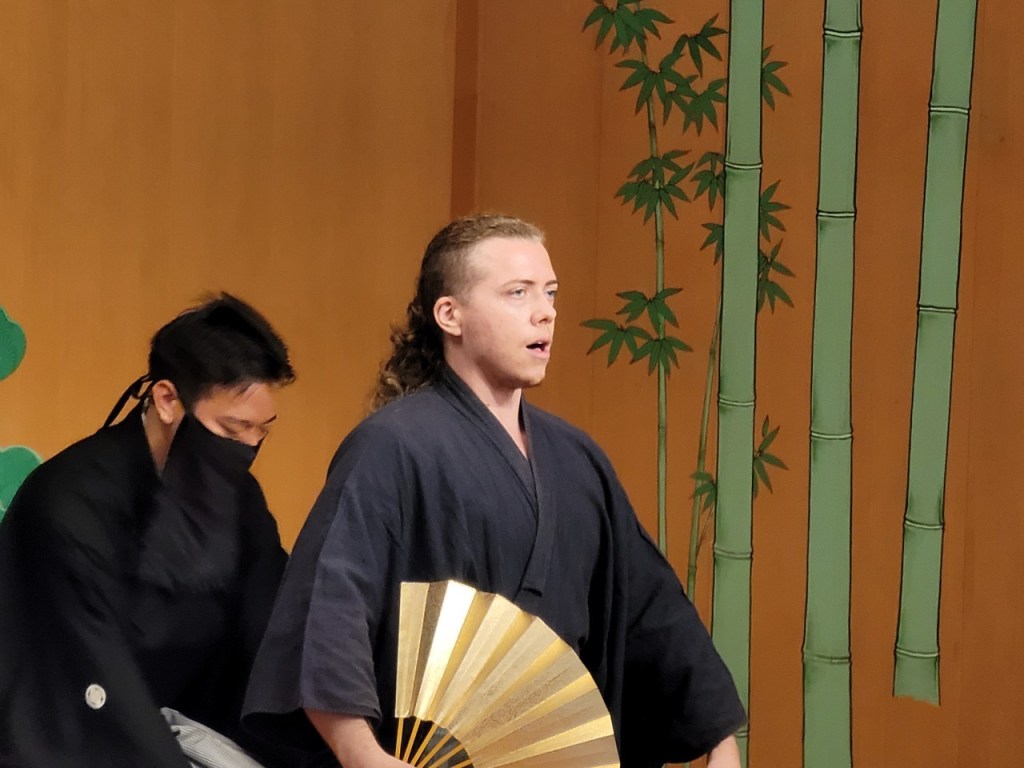
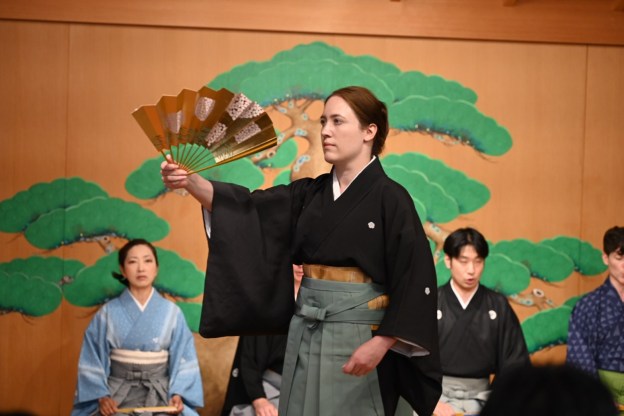
Culminating in the programme was the privilege of participating in a Noh performance on the closing day. Each participant chose one of the three dances we studied to bring to the stage, and in the end our teachers also contributed their pieces. Coming back to the before mentioned pondering of how the teachings of the way are reflected in Noh, I believe this shapes not only the performer but also deeply resonates with the audience. As a result the audience is invited not just to a theatrical spectacle but to witness an expression of spiritual value.
In conclusion, the summer intensive programme at the International Noh Institute offered a transformative journey into the world of Noh, fostering artistic appreciation but also intellectual growth and personal reflection that goes deeper than just the movements one might perceive on the stage. The opportunity to learn directly from accomplished Noh masters, engage in profound discussions, witness captivating demonstrations and perform on stage contributed to a deeply enriching experience.










 The International Noh Institute