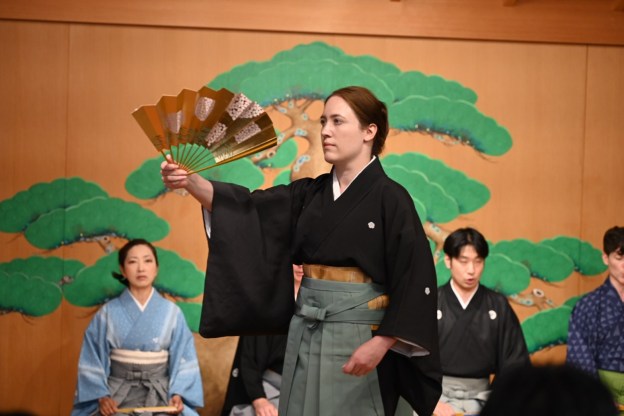
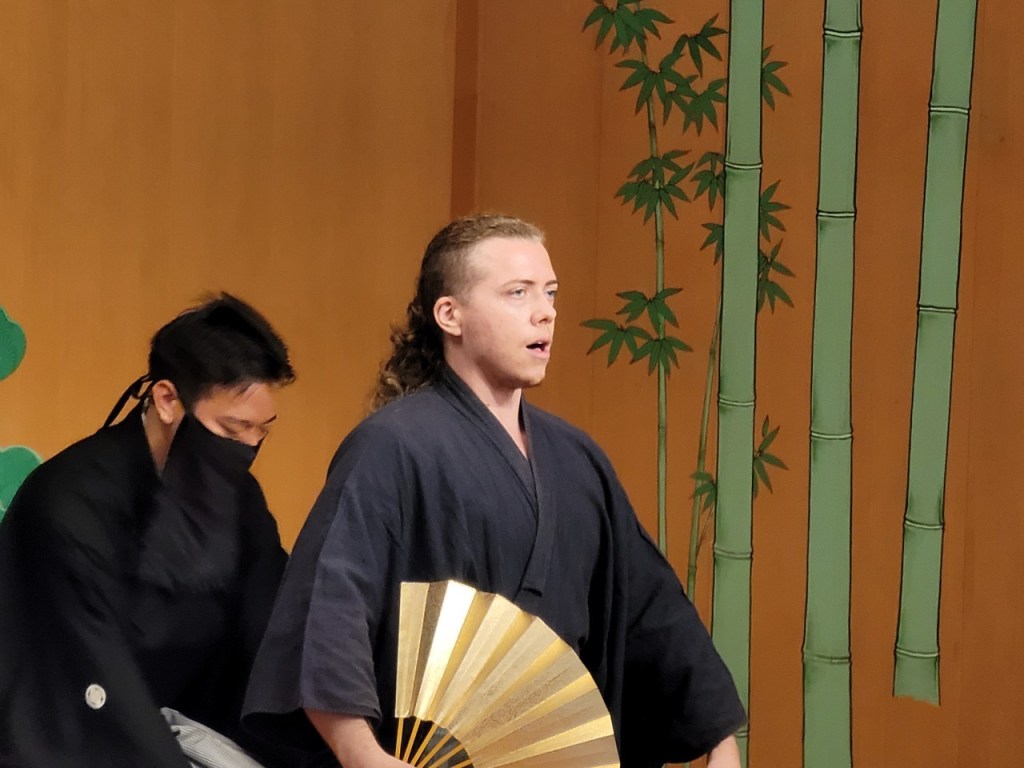
During my two-week training with INI, I had the opportunity to experience and embody nō forms and expressions while learning about the philosophy behind them. We formed a warm and supportive group, practicing together with the teachers every day. The final recital was incredible, and performing on stage alongside professional actors was an unforgettable experience.
To start to know noh, you must know humility. As children, learning to walk is a milestone, and for noh, it is the same. When you are asked to forget what you understand about standing and begin to move as demons, divine beings, and wandering humans, you strip away the attachment to being right, and instead devote yourself to curiosity.
My greatest takeaway from INI’s Noh Intensive is that the simplest gesture or the thinnest wrinkle carved upon a mask can have the grandest meaning. Whether you are the suffering Yuya scanning the horizon for the solace of sakura, or Shojo bestowing the gift of everlasting sake to the generous shopkeeper, all these can be encapsulated in the gaze of the face or stream of the arm. Although there may have been fumbled footwork or warbled words, our eager inquiry into the imagery of the art form stripped us of our pride so we could breathe inside each character.
As the final demonstration ended, my reaction when ducking through the stage door was, “I wish I could perform again.” To me, that is the true sign of inspiration: longing to learn and share more. From the tips of my tabi socks to the final fold of the fan, I hope to humbly offer my knowledge of this art form to others through my work as an educator and writer. May this be the first step, the first kata, in a lifelong dance of coming to know Noh, and cheerily chanting that song to anyone willing to sing along.
The INI Summer Intensive 2024 was an invaluable experience, offering a rare opportunity to engage deeply with the world of Noh. The program culminated in a full day of performances, where we presented the dances we had trained for during the two weeks.
A key highlight of the program was the diverse team of instructors. Lessons were led by Noh Masters Udaka Tatsushige and Udaka Norishige, Professor Diego Pellecchia, and Mask Carver Udaka Keiko. Each brought a unique perspective to teaching Noh, enhancing our understanding of the complexity behind its stylized tradition.
I felt that this year was particularly special, as Diego Pellecchia featured his performance of Funa Benkei, an unforgettable Noh play. This gave us a rare glimpse into backstage practices and allowed us to witness a very rare rehearsal process firsthand, unusual for the world of Noh professionals. We also attended two additional plays, which we discussed together, enriching our appreciation with Diego’s expert insights.
Beyond the structured lessons, the program fostered casual conversations, creating a relaxed atmosphere where participants could ask questions freely. These spontaneous exchanges often led to profound discussions, enriching our learning experience even further.
Finally, I must mention the unique training environment of the INI program, the Udaka family’s training space. For me, it is an incredibly special place. INI offers the chance to train in the same space where Noh is taught and practised daily. Every time I entered, I felt a sense of humility and excitement, surrounded by the tools, books, and materials that speak to the living tradition of Noh and its daily life practices.
I am deeply grateful to the Udaka family and Diego Pellecchia for their intellectual generosity. I highly recommend the INI Summer Intensive Program to anyone interested in exploring the world of Japanese Noh theatre.
I am a PhD student under the supervision of Prof. Dr. Christine Greiner. My research focuses on nō as an important theatrical pedagogical tool for the training of both Japanese and foreign actors, maintaining the structure and content of traditional training while fostering theatrical pedagogical exchange. The aim is to create a “nō without borders” that continues to resonate today, both in Japan and in the West. For these foreign actors to engage with nō, they received support from masters with an intercultural vision, such as Udaka Michishige Sensei and Rebecca Teele Ogamo Sensei, among others at INI. Throughout my studies, I found it crucial to complement the bibliography I was reading with practical experience and hands-on training at INI.
During the two-week practical studies for my theoretical research, I particularly appreciated the interaction with the masters, who demonstrated attentiveness and specific pedagogical skills crucial to nō training. The INI provided a welcoming and supportive atmosphere, where I felt part of a family, with everyone contributing to each other’s progress. Experiencing the support, encouragement, and joy from the masters as they guide you is one of the most valuable memories to cherish for a lifetime.
I am deeply grateful to everyone who has supported me along this journey in life and scholarship. Special thanks to Christine Greiner Sensei, Rebecca Teele Ogamo Sensei, Udaka Tatsushige Sensei, Udaka Norishige Sensei, Udaka Keiko Sensei, Diego Pellecchia Sensei, and Monique Arnaud Sensei.
Prior to the INI summer intensive program, my understanding of dance and drama was limited to the Western context. Further, my appreciation for the potential of the two was restricted by my cultural upbringing. During the two weeks of the program, through the instructions of the teachers, I learned to appreciate the depth of what Noh could be. Daily teachings and interactions with the teachers and hearing about the many plays and stories we could perform changed my view of how one could engage with a cultural activity and live life through its vehicle. Learning the chanting, the dancing, as well as the forms and symbols was challenging but deeply rewarding. To ultimately perform a Noh piece, as the culmination of days of hourly practice, was one of my proudest moments. I would recommend the summer intensive program to anybody who is interested in appreciating and understanding the potential of a tradition with a rich history that continues to thrives in modern times through its impact on those experiencing it.
I came to know nō theater through practicing traditional Japanese dance and watching the performance of the play Shakkyō in Hong Kong, where I was captivated by the mystery and mastery of nō. After facing various difficulties and setbacks in 2023, it was a great honor for me to participate in a two-week intensive training program in Noh theater in Kyoto. Amidst the hot summer days and the vibrant atmosphere of the Gion Festival, the two weeks of training allowed us to immerse ourselves in the artistic ambiance of Kyoto.
The three masters, Diego-sensei, Tatsushige-sensei, and Norishige-sensei, each possessed unique characteristics and taught the six of us, students from different parts of the world, in a meticulous and easy-to-understand manner. Diego-sensei offered detailed guidance on movements and storytelling; Tatsushige-sensei imparted wisdom from philosophical, Zen, and Shintō perspectives; and Norishige-sensei demonstrated movements akin to flowing water and gentle breeze, providing us with a full-body experience.
Although each student came from a vastly different background, everyone invested their wholehearted effort to excel. We were also fortunate to attend Keiko-sensei’s nō mask-making workshop, learn about the Gion Festival’s Yoiyama evening, receive assistance and translation from Monique-sensei, and have the experience of watching a Noh performance. In every aspect, the program provided a rich tapestry of nō-related experiences within the brief span of two weeks.
I am grateful for the encouragement and inspiration I received from the masters, which enabled me to participate with great honor in the final Noh theater performance, showcasing the fruits of two weeks of intensive training to family and friends. As the training period flew by, I found myself wishing that time could stand still to preserve these wonderful memories. I extend my gratitude to everyone who contributed to making this experience possible and to all my friends for their unwavering support.
Having the opportunity to learn and immerse myself in Noh theater in Japan under the guidance of Diego Sensei, Tatsushige Sensei, Norishige Sensei, Keiko Sensei, and Monique Sensei has been a life-changing experience that I will cherish for the rest of my life. I am grateful for the wise words, love, and passion that you have all shared with me, and for the trust that you have placed in me. You have helped me to fall even more in love with Noh and with my profession.
This summer, I had the privilege of joining five other participants from around the world in the esteemed Summer Intensive Programme of the International Noh Institute.
Central to the programme was the invaluable access to renowned Noh teachers, namely Udaka Tatsushige, Udaka Norishige and Diego Pellecchia, as well as the support and kind guidance of Monique Arnaud. Their expertise and dedication to preserving Noh as an art form were evident throughout their teachings.
Beyond the technical aspects of Noh – namely lessons on chanting and studying the movements known as kata which make up the dance part – the programme encouraged profound discussions on the artistic and philosophical underpinnings of the Noh plays and the essence of Noh itself. These in-depth conversations highlighted the spiritual dimensions of the performances.
One thought which crossed my mind was about how the essence of noh bears many similarities to the traditional concept of ‘the way’ or ‘dō’(道) ‒ evident in practices like the Way of the tea (Sadō), the way of the Sword (kendō) or the Way of the Brush (Shodō). Noh theatre, much like the traditional ways, places emphasis on dedicated practice, honing skills over a lifetime and seeking a deeper connection with the art itself. The philosophy of self-improvement and enlightenment, inherent in the ways, is equally present in the practice of Noh. Discussing this shared ethos between Noh theatre and the philosophy of the way with our teacher highlights how Noh is transcending the surface of a mere theatrical performance into a holistic art form encompassing spiritual and philosophical aspects, making Noh a transformative journey for the performer.
Another particularly memorable and spontaneous occurrence emerged during a discussion on masks from the Noh play Kanawa. As a thunderstorm raged outside we were shown the corresponding mask to the play with the lights turned off and just a single candle lit, creating a captivating atmosphere and highlighting the masks man facets so different to the masks we see in artificial light.
Since masks play a central role in Noh theater, interacting with mask carver Udaka Keiko was undoubtedly one of the highlights. She patiently listened to our many probing questions and showed us a large repertoire of different masks.
Culminating in the programme was the privilege of participating in a Noh performance on the closing day. Each participant chose one of the three dances we studied to bring to the stage, and in the end our teachers also contributed their pieces. Coming back to the before mentioned pondering of how the teachings of the way are reflected in Noh, I believe this shapes not only the performer but also deeply resonates with the audience. As a result the audience is invited not just to a theatrical spectacle but to witness an expression of spiritual value.
In conclusion, the summer intensive programme at the International Noh Institute offered a transformative journey into the world of Noh, fostering artistic appreciation but also intellectual growth and personal reflection that goes deeper than just the movements one might perceive on the stage. The opportunity to learn directly from accomplished Noh masters, engage in profound discussions, witness captivating demonstrations and perform on stage contributed to a deeply enriching experience.
We decided to hold the INI Summer Intensive Workshop in the summer of 2022, while Japan still kept its borders closed to those without a residence/work/study visa, knowing that it would be difficult to welcome guests from abroad. We were glad to receive a number of requests, though only two applicants, Arden Taylor (USA) and Florian Ehrard (GER) were eventually able to participate. While Florian already studied with the INI in the past, Arden joined us for the first time. Arden was kind enough to sent us a thoughtful reflection on the his experience with the INI.
Diego Pellecchia – INI Program Coordinator
I consider myself extraordinarily lucky to have had the chance to participate in the International Noh Institute’s summer training program 2022. I am still a novice in noh, having begun my studies of the texts in the third year of my MA at the University of Washington’s Japanese literature program. There is so much to explore just in the renga-influenced text itself, even though I do enjoy the performances, that I assumed (as is perhaps the vice of most literature majors) that the most interesting part of noh was its text. I never could have imagined, before experiencing it first hand, what it really means for a performance tradition to be “transmitted.”
For this year’s program, we had three instructors: Diego Pellecchia, Udaka Tastushige and Udaka Norishige. Diego was our contact while preparing for the program, and was the most strict with us (which I was grateful for) about etiquette during practice. As an American, and particularly a white masculine academic, I recognize the need to practice cultural appreciation rather than appropriation, and Diego was able to help us to be as respectful as possible and to convey our gratitude. Diego is also a professor at Kyoto Sangyo University, which means that he was able to impart not only the practical, but also the academic features of noh throughout our practice. Diego’s passion for the art is contagious, and the seriousness with which he treats it gives weight to everything we do together.
The two brothers who were our main instructors, Udaka Tatsushige and Udaka Norishige, had nearly opposite teaching styles, but both myself and my cohort agreed that we felt incredibly lucky precisely because of this. The two styles could be summarized thusly: start from the mind, and start from the body. Like Diego, most of Tatsushige’s lessons were conducted in English. Tatsushige speaks excellent English and takes a very cerebral approach to his practice, which he is very good at conveying. He claims that the process of learning noh was not instinctive for him, and exactly because of that, he developed his own method for conceiving of the motions and intentions behind standard forms in the dance and acting aspects of the performance. It is difficult for me to put into words how much I felt was generously given to me in our talks between practice.
Norishige, on the other hand, more often focuses on the precision of the movements themselves. He speaks in a soft and endearing Kyoto accent, and most often arrived to practice in a yukata. On our first day, he offered us tea and Japanese sweets with the traditional Kyoto omotenashi (welcoming spirit). In addition to the precise corrections of our movements (which effectively cross any language barrier, as they only require observation and imitation), Norishige also took the time to share aspects of the practice that he himself finds fascinating. Among these were photographs of performances he and others had partaken in, as well as the depth and complexity of the musical accompaniment to full noh performances. On one afternoon, I arrived to the training space to find him practicing the kotsuzumi (the smaller of two drums usually included in performance). Although it sounded just like a performance drum to me, he laughed and kindly explained that this was a practice drum, with synthetic materials that – though perfectly suitable for practice – lacked the warmth, resonance, and indeed the organic nature of the true instruments. Numerous engages like this with all three instructors added immeasurable depth and value to the experience, which I am now struggling to put into words.
This year, we also had the additional treat to be able to observe and learn about mask carving from another of the Udaka siblings, Udaka Keiko. Keiko was extremely patient and just as forthcoming as her brothers in explaining her philosophy toward the art, though indeed quite different from the performance aspect. I was taken aback not only by the extremely time-consuming and diligent process of construction, but by Keiko’s unique relationship with her art. She explained that, while the heights in artistry achieved with the Sengoku Period (1467-1615) masks have likely been unmatched even today – resulting in the prevalence of copy-making within the industry – there is never a peak or final stage in the world of art, even one as steeped in tradition as noh. To move past what seems to be a peak in aesthetics requires innovation, and also courage, and yet to reach that point in the first place also requires a lifelong devotion to the history and living nature of the art as it exists today.
I had initially planned to extend my stay in Japan and try another noh training program as well, which also happened to be run out of Kyoto, even though the Kongo School is the only one of the five main noh schools consistently active since the Muromachi Period (1336-1573) that is based in Kyoto. As it happens I was not able to change my flight, but – even though I am loath to leave Kyoto – I am paradoxically grateful for this too. I admit a slight obsession with noh, to the extent that I would gladly take any opportunity to learn more about it. But my main takeaway from this program is, as I said at the start, the importance of transmission.
Noh is not the kind of art that can be explored or studied on one’s own, no matter the effort. It is not a static object that can be bought or handed off at a distance. It is a living tradition that has been conveyed to the present day, master to pupil, for the last seven centuries. While the basics of the art remain the same in each of the five schools, the deeper understanding of what precisely is aesthetically the most appealing and why are unique to each school. But most importantly, noh practice is not simply “practice,” but – as explained by Tatsushige – a combination of “renshu” and “keiko.” While both of these words translate to English as “practice,” only renshu refers to the simple process of repeating certain actions until muscle memory is created. “Keiko” on the other hand involves something much deeper. It involves relationships; between one’s teacher and oneself, oneself and one’s fellow students, and perhaps most of all, between oneself and the piece one is practicing. Anyone can perform the movements in noh, as few are physically demanding and modifications exist for any movements that are. But the main thing that I learned, especially from watching my teachers perform on our last day together, is that two people performing the same piece, even doing the same movements to millimetric precision, will not produce the same results.
Noh is not just an art in itself, it is a tradition that is passed from person to person. Part of that tradition includes a relationship with one’s teacher. It is through this relationship that one achieves understanding of each individual piece, and it is only upon achieving this understanding that the potential for achieving mastery lies. It is said that one cannot be considered a master of noh until reaching the age of sixty, at which point one is considered likely proficient enough to perform certain pieces considered to be of particularly high (or “heavy” in Japanese) kurai (rank). In other words, true mastery of noh requires a lifelong practice, and even then, there are still depths to be reached within this rich tradition. Part of our keiko necessarily included sharing a part of ourselves with our teachers, as they did with us. In that way, as the tradition became a part of us, we too became a part of it.
I was especially lucky – although it is hard not to feel equally guilty about this – that the travel restrictions to Japan meant that there was only one student besides myself in the program this year. This meant that we were able to not only receive very individualized lessons, but also to share in just that much more time with our teachers. It would be difficult to choose a favorite aspect of the program, but the part I most miss is undoubtedly the conversations shared with them. Anyone can, and everyone should, take this incredible opportunity to take part in this centuries-long tradition of performing arts in Japan’s beautiful cultural capital.
Arden Taylor – INI Summer Intensive Program 2022
Arden TaylorArden Taylor (shimai: Iwafune kiri)Florian Ehrard (shimai: Ataka)
I am currently living in Japan, with a Cultural Activities Visa that allows me to make a tailored program for myself. In addition to Noh Theatre, I am also currently studying butoh, kyūdō, and several dance styles. I arrived in Kyoto after having studied the Ko-tsuzumi for a few months in Kanazawa. I was lucky enough to get into Japan, considering the global pandemic that was going on. This also explains the special conditions in which I took the Summer Intensive Course. I was the only student who was able to get into the country. Therefore, my experience was, once again, quite unique.
Alice Milluy – shimai “Yuya”
I was born in a family that treasures the arts and have always felt a strong connection to them, especially theatre. I first encountered Noh through a workshop I took out of curiosity a few years ago, when I was living in Belgium. I was practicing Iaido at the time and it seemed like a natural meeting point between Japanese Martial Arts and Theatre.
At first, I didn’t really know what to think of it. I knew I was in love with it, but couldn’t explain where my fascination for it was coming from. Everything about it seemed like it came from so far away that I doubted I would ever begin to understand it. I imagined it’d be a one-time workshop that’d just be a little experience outside my comfort zone.
I entered a Lecoq Technique Movement Theatre school in Brussels. That’s where I crossed paths with Noh again. Indeed, part of Jacques Lecoq’s work method was created from research and work with Noh professionals; mask-makers, and actors. This discovery, among other things, made me realize that, to become the actress I wished to be, I needed to broaden my horizons and truly emerge myself in foreign performing art forms, and that Japan was the place where I’d start my research. With all that in mind, I participated in the Intensive Summer Workshop at the INI in Kyoto.
My time with Udaka Tatsushige-sensei wasn’t just about learning to dance and to sing one piece. I am truly thankful for the gift of time and of knowledge he gave me. He made me see that Noh is more than just an ancient art form, but that it has very modern sides to it, that it evolves while respecting its roots. What makes it come to life, and, in my opinion, has helped to keep it alive for so many centuries, is its unique structure and the dedication with which it was passed onto the following generations. Being able to witness it, and to get a glimpse of what it means to be a Noh professional (an actor, mask-maker, or even musician), was incredibly inspiring to me. When I arrived on the first day, my knowledge of Noh theatre was similar to a seed that had just been planted in fresh ground. It needed that little push for its roots to go through the shell, and for the plant to start growing in hope of reaching the surface.
On a more personal note, I can say that Noh gave me a kind of stability that I’d never experienced before. Working with kata that have been passed down for hundreds of years gave me a feeling of safety and grounding during the practice. Repeating, again and again, the same movements without having to question myself every step of the way was very refreshing. The different concepts found in the practice of Noh showed me a new way to work on my future projects.
Udaka-sensei’s teaching method helped me get rid of the feeling of being just an outsider trying to get a grasp of a different culture. Through conversations before or after okeiko, he shared his insights with me and helped shape the way I look at theatre today. And for that, I will always be thankful to him and to the INI members. There is an infinitely long path ahead of me. One that I cannot wait to continue walking on.






 The International Noh Institute